Published
January 18, 2025
Simple explanation of VLM technology and how it 'sees' document layout, which is crucial for complex ESG forms.
Your compliance team keeps hearing about “VLMs” and “Vision-Language Models” in industry discussions. But what exactly are they? How do they differ from the OCR systems you’ve used for years? And—more importantly—why should you care about them for ESG compliance under CSRD, SEC, and ISSB reporting requirements?
This guide explains VLM technology in plain English. You’ll learn what it is, how it works, and why it matters for processing ESG documents at scale.
The key difference upfront: Modern VLMs achieve 99.35% accuracy on ESG documents, compared to 85% for traditional OCR. The improvement comes from understanding document layout, not just recognizing characters. This matters because tables contain 68% of structured ESG data, and traditional OCR struggles with tables.
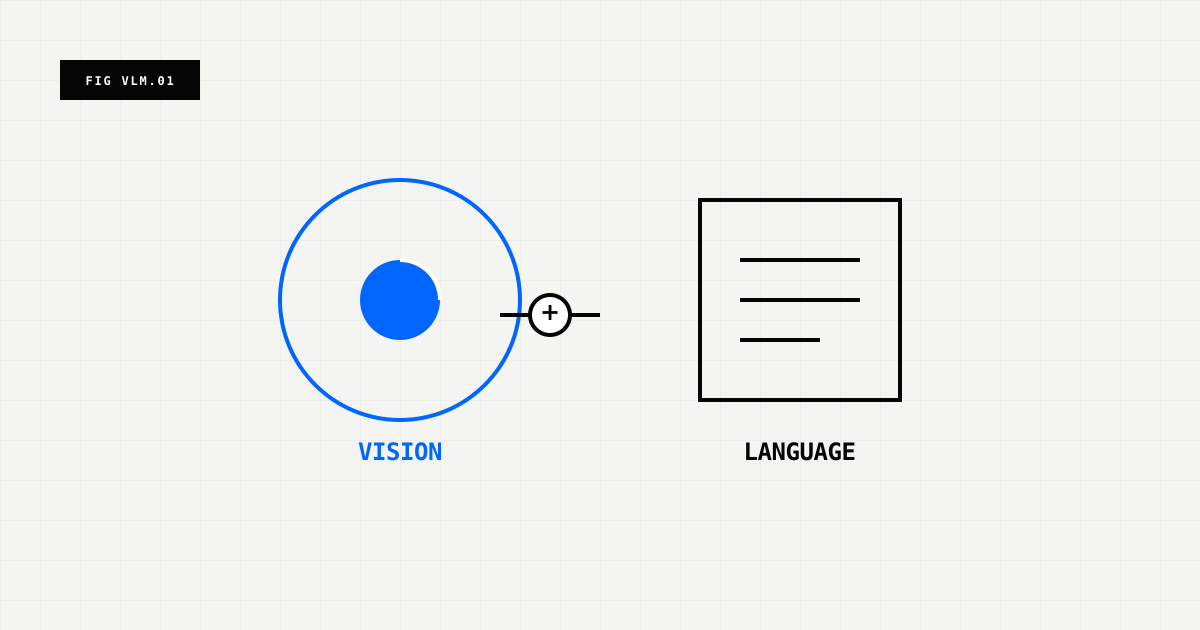
VLM stands for Vision-Language Model. Think of it as two systems working together:
When combined, these systems can look at a document and explain what they see in natural language, extracting structured data instead of just raw text.
Traditional OCR (Optical Character Recognition) focuses on one task: recognizing individual characters. It converts “15.000 kWh” into text, but it doesn’t understand what those characters mean.
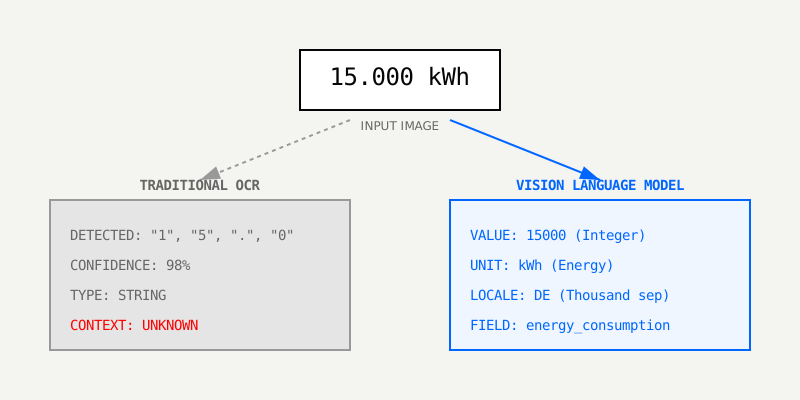
Here’s the problem: when OCR encounters “15.000 kWh” in a German electricity bill, it extracts the text but can’t answer basic questions:
A VLM approaches this differently. It sees “15.000 kWh” in the context of the entire document and understands:
energy_consumption_kwh field in your databaseThis contextual understanding is what makes VLMs useful for ESG compliance.
A VLM works through three steps when analyzing a document. Here’s what happens when you upload a German electricity bill:
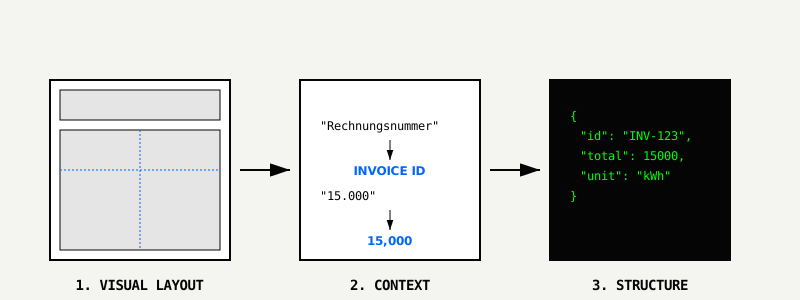
First, the vision component identifies the document structure, similar to how a human eye scans a page:
Rather than seeing a wall of text, the VLM recognizes this as a structured document with specific sections and relationships.
Next, the language component extracts text while understanding meaning:
The model doesn’t just copy characters—it interprets them correctly based on language and format conventions.
Finally, the VLM combines visual and textual understanding to produce structured output:
{
  "invoice_number": "12345",
  "billing_period": {
    "start": "2024-01-01",
    "end": "2024-01-31"
  },
  "meter_reading": {
    "current": 15234,
    "consumption": 2889,
    "unit": "kWh"
  },
  "cost": {
    "amount": 823.45,
    "currency": "EUR"
  }
}
This JSON can flow directly into your ESG reporting system without manual data entry or reformatting.
ESG compliance presents four specific challenges where VLMs outperform traditional OCR.
Sustainability reports, emissions questionnaires, and climate disclosures rarely use simple layouts. They contain:
Traditional OCR treats everything as sequential text, losing the structural relationships. When faced with a supplier emissions questionnaire containing 3 tabs, 12 tables, and 47 questions, OCR extracts all text as a single block. A VLM navigates the tabs separately, locates specific tables, and preserves the question-answer relationships.
ESG reports frequently reference other documents: methodology appendices, external standards like the GHG Protocol, or supporting data from supplier questionnaires.
VLMs recognize these cross-references and can maintain linkages between related data points across documents. This enables traceability—knowing exactly where each data point originated—which is essential for audit trails.
European companies process documents in 24+ languages. A utility bill arrives as “Stromrechnung” in German, “Facture d’électricité” in French, “Bolletta luce” in Italian, or “Factura de luz” in Spanish.
Traditional OCR requires separate language-specific models. VLMs handle all languages within a single model, understand regional format variations (European decimals like 1.234,56 versus US 1,234.56), and normalize everything to consistent English JSON output.
The majority of structured ESG data lives in tables—utility bill rate schedules, emissions breakdowns, supplier response matrices, climate risk scenario analyses. This is problematic for traditional OCR because tables account for the largest accuracy gap: 68% accuracy compared to 94%+ for plain text.
VLMs understand two-dimensional table structure. They recognize headers, handle merged cells and multi-row headers, and preserve the relationships between row and column labels. This means they extract “Scope 1 emissions: 4,500 tCO2e” correctly even when the table spans three pages with merged header cells.
Independent testing from MMESGBench (2025) compares VLM performance against traditional OCR across document types common in ESG workflows:
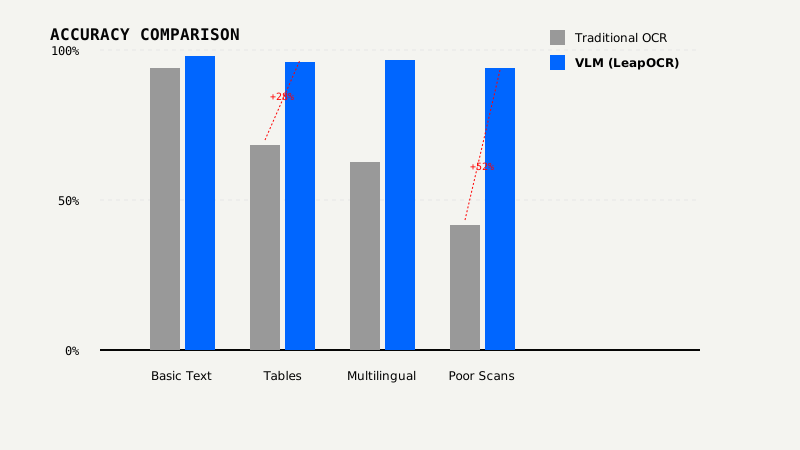
| Document Type | Traditional OCR | VLM | Improvement |
|---|---|---|---|
| Simple text | 94.2% | 97.9% | +3.7% |
| Tables | 68.3% | 96.1% | +27.8% |
| Multi-page | 72.1% | 94.7% | +22.6% |
| Multilingual | 62.5% | 96.8% | +34.3% |
| Poor scans | 41.7% | 94.2% | +52.5% |
Three factors explain the performance gaps:
Tables: When OCR encounters a table, it sees text lines. When it outputs “Row 1: Header1 Header2 Row2: Data1 Data2,” you lose the column structure. A VLM recognizes “Table with 2 columns, 1 header row, 1 data row” and preserves those relationships.
Multilingual content: Traditional OCR requires separate models for each language. You’d need one model for German documents, another for French, a third for Italian. VLMs handle 100+ languages within a single model, eliminating the complexity of language detection and model switching.
Poor quality scans: When a scanned document has noise or artifacts, OCR produces garbled output like “1 .3 5 kWh.” VLMs use contextual clues—a partially visible label, surrounding numbers, document type—to infer “15,345 kWh” correctly.
Let’s look at three concrete ways compliance teams use VLMs in practice.
Companies subject to CSRD must collect ESRS E1 (Climate Change) data from utility bills, energy certificates, supplier questionnaires, and climate scenario analyses.
A VLM-powered workflow automates this:
This approach typically reduces manual data entry by 95% while maintaining 99%+ accuracy.
When assessing 200 suppliers across ESG policies, emissions data (Scope 1-3), certifications, and due diligence questionnaires, VLMs accelerate the process:
Teams using this approach report an 80% reduction in supplier assessment time.
External assurance requires traceability—you need to show where every number came from. VLMs build this audit trail automatically:
This reduces audit preparation time by 70% and results in smoother audits with fewer findings.
The terminology can be confusing. Here’s the distinction:
LLMs (Large Language Models) process text only. If you paste text from a utility bill into an LLM and ask it to extract energy consumption, it works with the text you provide. But it cannot see the original document, the table structure, or the visual relationships between fields.
VLMs (Vision-Language Models) process images and text together. When you upload a PDF bill to a VLM, it sees the document layout, understands the table structure, and recognizes how labels relate to values.
Most ESG workflows use both technologies together:
For example, a VLM extracts “Scope 1 emissions: 4,500 tCO2e” from a PDF report, while an LLM analyzes the surrounding text and notes that the company describes its target as “ambitious” but lacks third-party verification. Together, they provide both the numbers and the context.
When evaluating VLM solutions for ESG compliance, six capabilities matter most:
| Capability | Why It Matters for ESG |
|---|---|
| Multilingual support | Process documents from 24+ EU countries |
| Table understanding | Extract emissions data correctly from tables |
| Handwriting recognition | Process site inspection notes and signed forms |
| Cross-page analysis | Handle multi-page questionnaires without losing context |
| Schema validation | Ensure output matches CSRD/ESRS requirements |
| Confidence scoring | Flag low-certainty extractions for human review |
Most providers offer tiered models:
| Model Type | Best Use Case | Cost Level | Expected Accuracy |
|---|---|---|---|
| Standard VLM | Clean documents with standard layouts | Low | 97%+ |
| Enhanced VLM | Complex tables and multilingual content | Medium | 98%+ |
| Pro VLM | Handwriting and poor quality scans | High | 99%+ |
A practical approach: start with the Standard tier, then upgrade to Pro only if you encounter handwriting or poor scan quality that affects accuracy.
Not all documents need VLM processing. Look for these characteristics:
Common starting points for ESG teams: utility bills (high volume, multilingual), supplier questionnaires (complex tables), energy certificates (varying formats), or site inspection logs (handwriting).
Before processing, specify the data structure you need. For utility bills, this might look like:
{
  "document_type": "utility_bill",
  "facility_id": "MUC-01",
  "billing_period": {
    "start": "2024-01-01",
    "end": "2024-01-31"
  },
  "energy_consumption_kwh": 15234,
  "renewable_percentage": 35.2
}
This schema ensures the VLM extracts data in the exact format your systems require.
Most VLM platforms use natural language templates. A utility bill template might include:
Extract the following fields from utility bills:
- Facility ID (if present)
- Billing period (start and end dates)
- Energy consumption in kWh
- Renewable energy percentage (if specified)

For multilingual documents, note:
- German "Stromrechnung" = electricity bill
- French "Facture d'électricité" = electricity bill
- Convert European decimals (1.234,56 to 1234.56)
- Convert European dates (DD.MM.YYYY to YYYY-MM-DD)Here’s a practical implementation using Python:
from leapocr import LeapOCR

client = LeapOCR(api_key=os.getenv("LEAPOCR_API_KEY"))

# Process with VLM
job = client.ocr.process_file(
  file_path="utility_bill.pdf",
  format="structured",
  schema=utility_bill_schema,
  model="pro-v1"  # Use Pro for handwriting or multilingual content
)

result = client.ocr.wait_until_done(job["job_id"])

# Auto-approve high-confidence extractions
if result["pages"][0]["confidence_score"] >= 0.95:
  save_to_database(result["pages"][0]["result"])
else:
  # Flag lower confidence for human review
  flag_for_review(result)
This confidence threshold approach minimizes manual review while maintaining accuracy.
Four metrics indicate whether your VLM implementation is working effectively:
| Metric | Target Range | Measurement Method |
|---|---|---|
| Field-level accuracy | Above 95% | Sample 100 extracted fields, verify against source documents |
| Document-level accuracy | Above 90% | Percentage of documents where all fields are correct |
| Confidence calibration | ±5% | Fields marked 95% confident should be 95% accurate |
| Processing speed | Under 15 sec/page | Average time from upload to structured output |
Consider a monthly volume of 1,000 ESG documents:
VLM-powered processing:
Manual data entry:
At this volume, VLM processing saves approximately €6,730 per month—a 90% cost reduction. Savings scale linearly with volume, so larger operations see even greater returns.
Is VLM the same as generative AI?
No. VLMs are extractive—they pull existing data from documents without creating new content. Generative AI models like GPT create original text. For ESG data extraction, VLMs are preferable because every output must be traceable to a source document.
Do VLMs eliminate the need for templates?
Templates remain important. They guide VLMs to extract specific fields in consistent formats. Without templates, a VLM might extract correct data but in varying structures—making downstream processing difficult.
Can VLMs process handwritten ESG documents?
Yes, though this requires Pro-tier models. Handwriting recognition achieves 99%+ accuracy for printed text and 95%+ for cursive handwriting. Site inspection notes and signed forms are common use cases.
What about data privacy and sovereignty?
This is particularly relevant for EU companies subject to GDPR. Look for EU-hosted VLM providers that process data within European data centers and avoid transfers to US servers subject to the CLOUD Act. Data residency matters for ESG compliance.
How do VLMs handle unusual or edge cases?
Confidence scores solve this problem. When a VLM encounters an unfamiliar format or ambiguous data, the confidence score drops below 95%. These low-confidence extractions route to human review, ensuring accuracy without manually checking every document.
VLMs represent a practical evolution in ESG document processing—moving beyond character recognition to true document understanding. For compliance teams facing CSRD deadlines, multilingual operations, complex document layouts, and external assurance requirements, VLMs address specific pain points that traditional OCR cannot.
The performance improvements are measurable:
These improvements translate to faster compliance cycles, lower processing costs, better data quality, and smoother audits. The technology is particularly valuable for companies operating across multiple EU countries, where multilingual document processing was previously a significant bottleneck.
Try it on your documents
Experience VLM-powered ESG extraction.
Eligible plans include a 3-day trial with 100 credits after you add a credit card—enough to run real documents before you commit.
Further Reading:
Try LeapOCR on your own documents
Eligible paid plans include a 3-day trial with 100 credits after you add a credit card, so you can test actual PDFs, scans, and forms before committing to a rollout.
Keep reading
More implementation guides, benchmarks, and workflow notes for teams building document pipelines.
Stop buying a separate AI tool for every department. Learn why a unified Vision Language Model (VLM) beats the 'point solution' approach in modern healthcare.
Global trade compliance is non-negotiable. Learn how automated document extraction and fuzzy matching create a robust, 24/7 sanctions screening shield.
Global trade doesn't happen in just English. Here is how Vision Language Models (VLM) handle commercial invoices, waybills, and customs declarations that mix languages and formats.