Published
January 26, 2026
Global trade doesn't happen in just English. Here is how Vision Language Models (VLM) handle commercial invoices, waybills, and customs declarations that mix languages and formats.
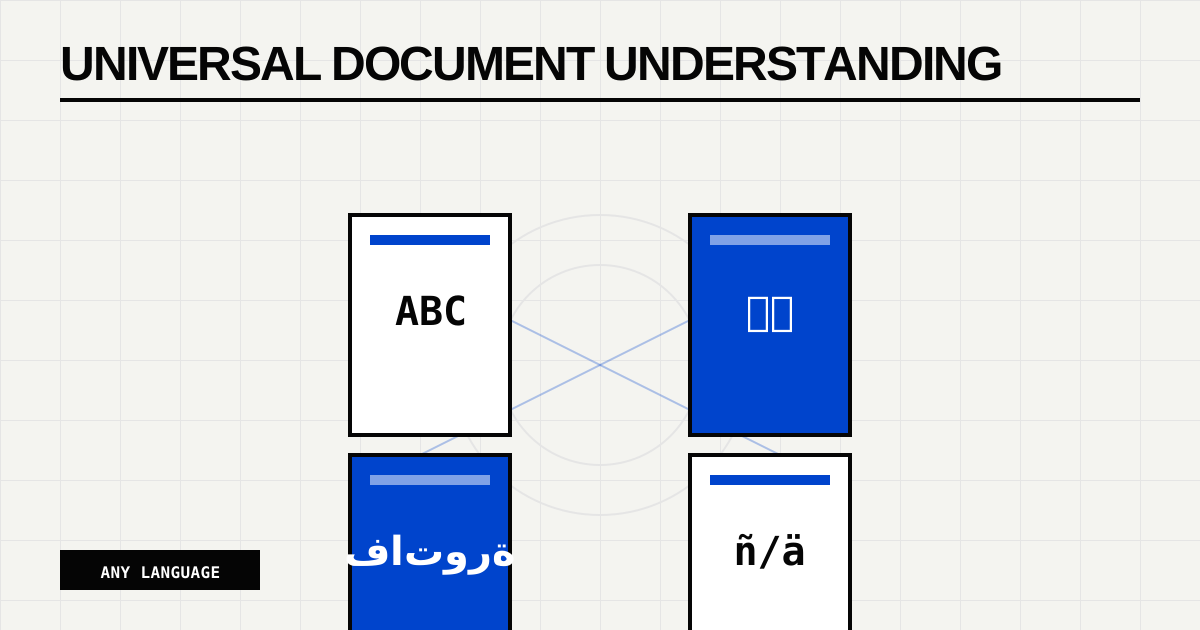
A shipping container moving from Shanghai to Rotterdam doesn’t just cross borders; it crosses language zones. The accompanying paperwork—Commercial Invoices, Bills of Lading, Certificates of Origin—is a chaotic mix of languages, scripts, and layouts.
For decades, logistics providers have tried to automate this with “OCR + Translation” pipelines. They usually fail.
Why? Because Standard OCR reads characters, not context.
When a traditional OCR engine sees “日期: 2025-10-12”, it might correctly extract the date. But if that date is floating in the top right corner without a clear English label, the system doesn’t know if it’s the Invoice Date, Shipping Date, or Expiry Date.
This ambiguity kills automation rates.
The industry standard for handling multilingual documents has been a fragile chain of tools:
This approach loses the visual semantic layer. “Total” means something different at the bottom of a column vs. next to a tax breakdown, but translation flattens that structure.
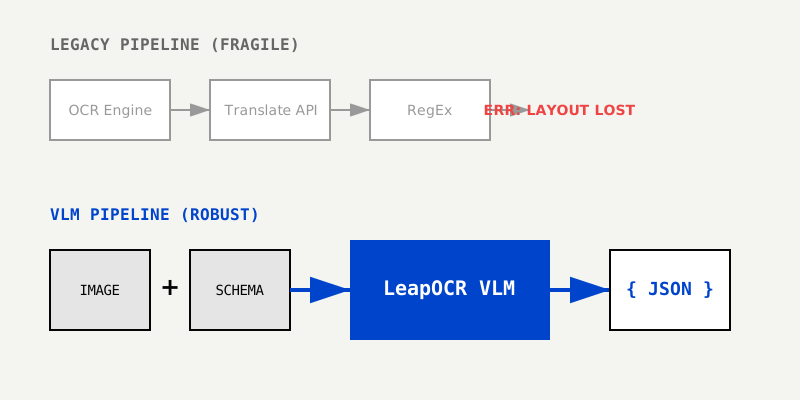
LeapOCR uses Vision Language Models (VLMs) to bypass this translation step entirely. VLMs like GPT-4o or Gemini 1.5 Pro are multimodal—they “see” the image and “read” the text simultaneously.
This allows for Zero-Shot Multilingual Understanding.
You don’t need to teach the model that “发票” means “Invoice” or that “فاتورة” means “Invoice”. The model understands the concept of an invoice across languages and visual layouts.
Consider a Commercial Invoice from a Shenzhen electronics supplier. It has:
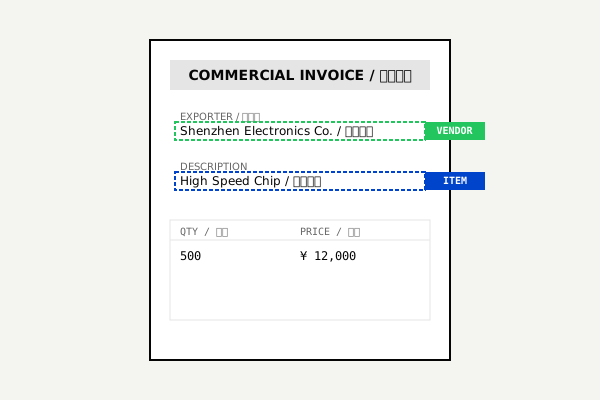
A VLM looks at this and understands: “This is the description column. The text is Chinese. I need to extract the Chinese text ‘高速芯片’ and map it to the item_description field.”
It doesn’t need to translate the whole document first. It extracts exactly what you need, in the language you need (or translated on-the-fly during extraction).
European languages are easy. But global logistics involves:
VLMs treat text as visual features, not just character codes. This results in drastically higher accuracy for non-Latin scripts.
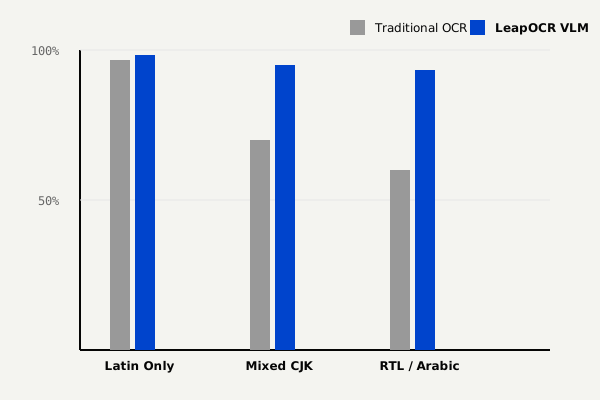
Fig 3.0 — While OCR handles English well, performance falls off a cliff with mixed Asian or Arabic scripts. VLMs maintain high accuracy regardless of the script.
The most powerful pattern we see is the Universal Schema.
Instead of building separate parsers for “German Invoices”, “Chinese Invoices”, and “Brazilian Invoices”, you define ONE universal JSON schema:
{
  "shipper": {
    "name": "string",
    "address": "string"
  },
  "line_items": [
    {
      "description": "string (translate to English)",
      "hs_code": "string",
      "value": "number"
    }
  ],
  "original_currency": "string (ISO 4217 code)"
}
You pass the document (regardless of language) to LeapOCR with this schema. The VLM acts as a universal translator and formatter, normalizing the chaotic input into clean, English-standardized JSON ready for your ERP.
If your supply chain is global, your extraction pipeline cannot be monolingual.
Stop cobbling together OCR and Translation APIs. Switch to a VLM-first approach that fundamentally understands the visual language of logistics, no matter what actual language is printed on the page.
Ready to go global?
Try LeapOCR on your own documents
Eligible paid plans include a 3-day trial with 100 credits after you add a credit card, so you can test actual PDFs, scans, and forms before committing to a rollout.
Keep reading
More implementation guides, benchmarks, and workflow notes for teams building document pipelines.

Robotic Process Automation (RPA) was a bridge technology. Learn why flexible Vision Language Models (VLM) are replacing brittle scripts in modern supply chains.

Stop buying a separate AI tool for every department. Learn why a unified Vision Language Model (VLM) beats the 'point solution' approach in modern healthcare.
Global trade compliance is non-negotiable. Learn how automated document extraction and fuzzy matching create a robust, 24/7 sanctions screening shield.