Published
January 18, 2025
Common pitfalls in ESG data collection (inconsistency, manual entry errors) and how AI-native OCR provides a solution.
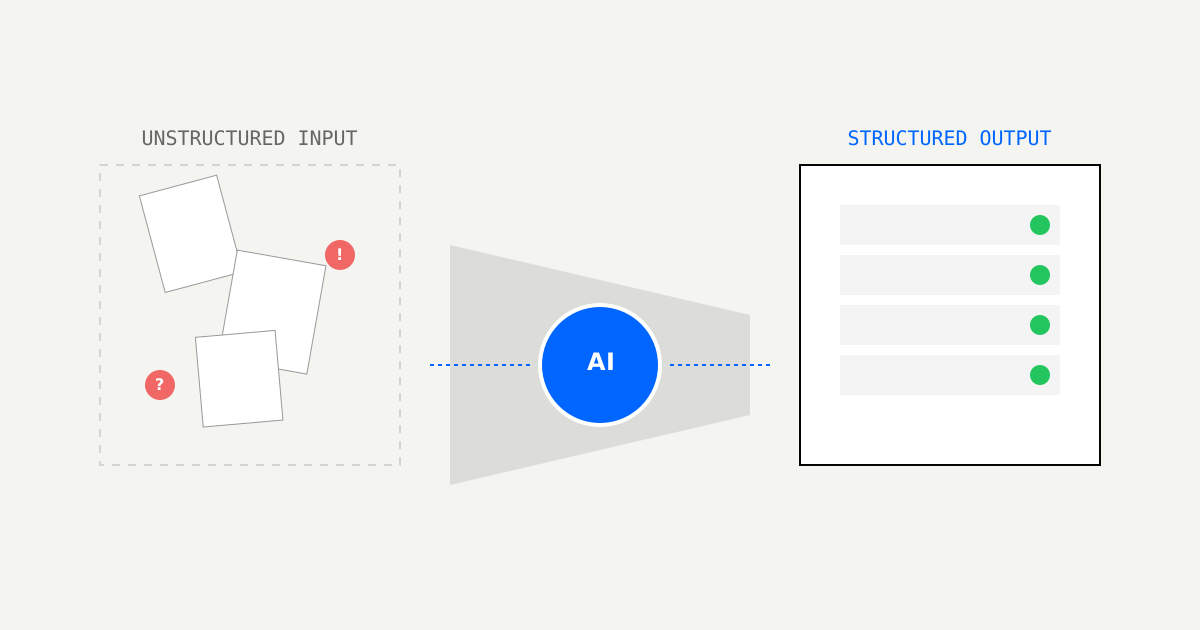
Your sustainability report shows Scope 2 emissions dropped 15% year-over-year. Then your auditor finds the “drop” came from unit conversion errors, missing facilities, duplicate entries, and data entry typos.
This isn’t a hypothetical problem. In 2023, 12% of EU companies restated ESG data after discovering quality issues. Under CSRD and SEC climate rules, those misstatements can mean fines up to €10 million or 2% of annual revenue.
Most organizations I talk to assume their data is fine until an audit proves otherwise. The problem isn’t negligence—it’s that ESG data collection is messy, fragmented, and surprisingly manual. Let’s walk through what actually goes wrong and how to fix it.
People typing data from utility bills and certificates make mistakes. Studies show human data entry hits about 89% accuracy for straightforward tasks, but drops to 75% for complex assessments. After two hours of continuous work, error rates climb to 18% due to fatigue.
The mistakes are predictable: transposing digits (“45230” becomes “45203”), misplacing decimals, confusing units (kWh versus MWh), and simple typos. One utility bill audit found a 15% error rate, mostly from decimal placement and unit confusion.
AI-based extraction consistently achieves 95-99% accuracy by eliminating the manual step entirely.
Every energy provider, supplier, and system seems to use different formats. German dates appear as DD.MM.YYYY, American dates as MM/DD/YYYY, and ISO dates as YYYY-MM-DD. Decimals flip between European notation (1.234,56) and US notation (1,234.56). Energy units vary across kWh, MWh, GJ, and therms.
Around 23% of ESG data quality issues stem from these format inconsistencies.
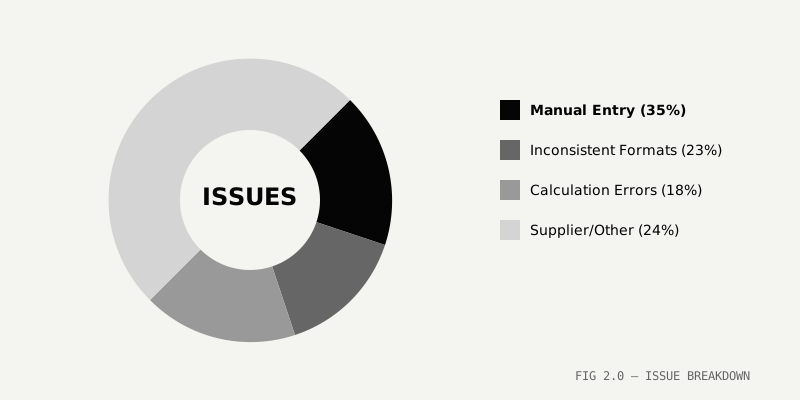 FIG 1.0 — Manual processes drive the majority of data quality failures.
ESG data lives everywhere: energy data in utility portals, emissions data in spreadsheets, supplier data in emails, certificates in shared drives, and travel data in booking platforms. A 2025 survey found 90% of organizations struggle with ESG data silos that create inconsistencies across reports.
Most teams catch data quality errors manually during review, if at all. Automated checks should flag obvious problems: renewable percentages over 100%, negative energy consumption, renewable kWh exceeding total consumption, or billing periods that end before they begin. About 15% of ESG data contains errors that basic validation rules would catch immediately.
Suppliers send revised emissions data, utility bills get corrected after initial upload, and spreadsheets accumulate changes without tracking. Without traceability, auditors can’t verify which version you used or when data changed.
Manual calculations introduce several failure points: using wrong or outdated emission factors, botching unit conversions (therms to kWh, gallons to liters), summing incorrect fields, or making spreadsheet formula errors. Calculation errors account for 18% of ESG restatements.
Your Scope 3 emissions depend on supplier data, but suppliers often provide incomplete or inaccurate information. In 2025, 79% of companies struggled with supplier data availability, 62% reported poor quality, and only 28% could track Scope 3 emissions comprehensively. Most companies end up estimating rather than using actual data.
AI extraction consistently achieves 99%+ accuracy on clean documents and 99.1% on handwritten text. More importantly, it assigns confidence scores to each field and flags uncertain data for human review. This approach drops error rates from 8-12% to under 2%.
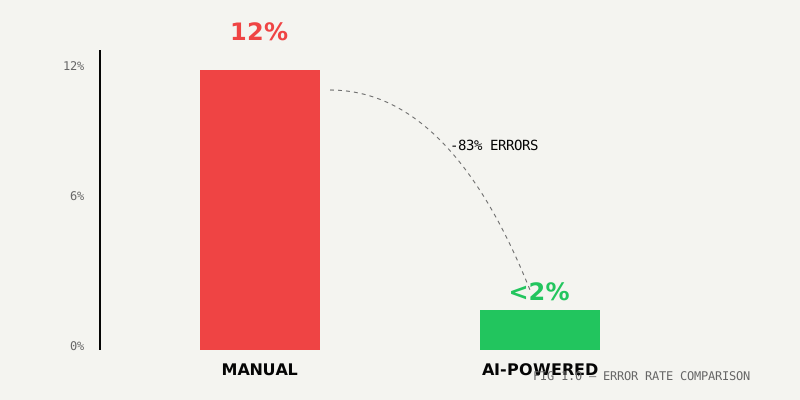 FIG 2.0 — Eliminating manual entry reduces error rates by over 80%.
AI recognizes regional format variations—German decimal notation, European date formats, multilingual text—and converts everything to a consistent output format. All dates become ISO 8601, all numbers use standard decimal notation, and units get normalized automatically. This means whether a supplier sends “1.234,56 kWh” or “1,234.56 kWh,” your system receives the same structured JSON.
Rather than manually consolidating data from portals, emails, and spreadsheets, an AI pipeline ingests documents from any source, classifies them automatically, routes them to the appropriate extraction templates, and outputs everything to a unified database schema. This creates a single source of truth for ESG data and eliminates manual consolidation.
JSON Schema validation catches errors at extraction time before bad data enters your system. You define the rules—renewable percentages must stay between 0-100, energy consumption can’t be negative—and invalid data gets rejected immediately for review.
Every extraction should include metadata showing exactly where the data came from: the source document URL, file hash, extraction timestamp, model version, confidence score, and who reviewed it. This creates a complete audit trail from source document to final report.
Instead of manual spreadsheet formulas, AI automatically applies the correct emission factors for each region, converts units consistently, aggregates data properly, and validates that totals match the sum of their parts. This eliminates the calculation errors that account for nearly one-fifth of ESG restatements.
AI can extract data from whatever format suppliers provide—PDF, Excel, Word emails—and normalize it to your schema. The system validates completeness and accuracy, then flags low-quality data for manual follow-up. Companies using this approach typically see supplier data quality improve from 60% to 95%.
The difference between manual and AI-powered data collection shows up clearly in the metrics. Companies making this shift typically see field-level accuracy jump from 88-92% to 97-99%, while error rates drop from 8-12% to under 2%.
More importantly, validation coverage goes from zero to 100%, format consistency reaches 100% across all data, and audit findings drop from 15-20 material weaknesses to fewer than 5. The restatement rate falls from 8% of companies to under 1%.
A European manufacturing firm needed CSRD compliance across 50 facilities in 12 countries. Their manual process took six months, produced an 11% error rate, required 23 audit adjustments, and carried high restatement risk.
After implementing AI-based extraction, data collection dropped to six weeks. Error rates fell to 1.8%, audit adjustments to just three data points, and restatement risk became minimal. The company saved €75,000 annually in rework costs and another €50,000 in audit fees.
Start with an assessment. Sample 50 data points across your document types and verify each field against the original source. Categorize the errors you find—entry mistakes, format problems, calculation errors, missing data—and calculate your baseline error rate. Most companies discover 10-15% error rates, 20% format inconsistencies, and 15% missing data.
Next, identify which problems cause the most damage. High-volume manual data entry might be your biggest issue, or maybe format inconsistencies across multilingual suppliers, or perhaps supplier data quality. Focus on the 20% of problems causing 80% of your errors.
Then build extraction templates for your highest-impact areas. Start with high-volume documents like utility bills and energy certificates, move to complex documents like supplier questionnaires, and handle multilingual documents last. Each template should define a JSON schema for validation and set confidence thresholds for automatic approval.
Implement automated validation checks that catch errors before data enters your system.
Finally, establish continuous monitoring. Sample 10-20 extractions weekly and verify them against source documents. Look for error patterns and refine your templates accordingly. Target metrics incrementally: under 5% error rate by month one, under 3% by month three, and under 2% by month six.
Poor data quality costs money. You’re likely paying for rework (50 hours per month at €40/hour equals €24,000 annually), audit adjustments (around €25,000 per year), and occasional restatements (€50,000 or more when they happen). That’s €27,000 to €102,000 annually in direct costs, excluding harder-to-quantify impacts like investor skepticism and regulatory fines.
The investment side breaks down into one-time costs (template development, integration, training around €30,000) plus ongoing expenses (API processing and oversight around €18,000 annually). First-year total runs about €48,000.
For companies losing €27,000 to €102,000 annually from poor data quality, that represents a 56% to 212% return on investment.
ESG data quality problems stem from manual processes, fragmented systems, and missing validation controls. These create regulatory risk, audit failures, and justified investor skepticism.
AI automation directly addresses each root cause: eliminating manual entry errors, normalizing inconsistent formats, centralizing scattered data, enforcing validation rules, tracking data lineage, automating calculations, and standardizing supplier data.
Companies investing in AI-powered data collection typically see 87% fewer audit adjustments, 80%+ reduction in compliance costs, faster reporting cycles, and verifiable data that builds investor confidence.
Your sustainability data should be 99% accurate, not 90%.
Next Steps:
Try LeapOCR on your own documents
Eligible paid plans include a 3-day trial with 100 credits after you add a credit card, so you can test actual PDFs, scans, and forms before committing to a rollout.
Keep reading
More implementation guides, benchmarks, and workflow notes for teams building document pipelines.

Robotic Process Automation (RPA) was a bridge technology. Learn why flexible Vision Language Models (VLM) are replacing brittle scripts in modern supply chains.
The warehouse receipt is the moment of truth for inventory. Learn how converting these documents into real-time structured data feeds eliminates shortage claims and speeds up order fulfillment.
Detention and demurrage fees are the silent killers of logistics margins. See how automated document processing stops the clock and saves $100+ per container daily.