Published
January 26, 2026
Detention and demurrage fees are the silent killers of logistics margins. See how automated document processing stops the clock and saves $100+ per container daily.
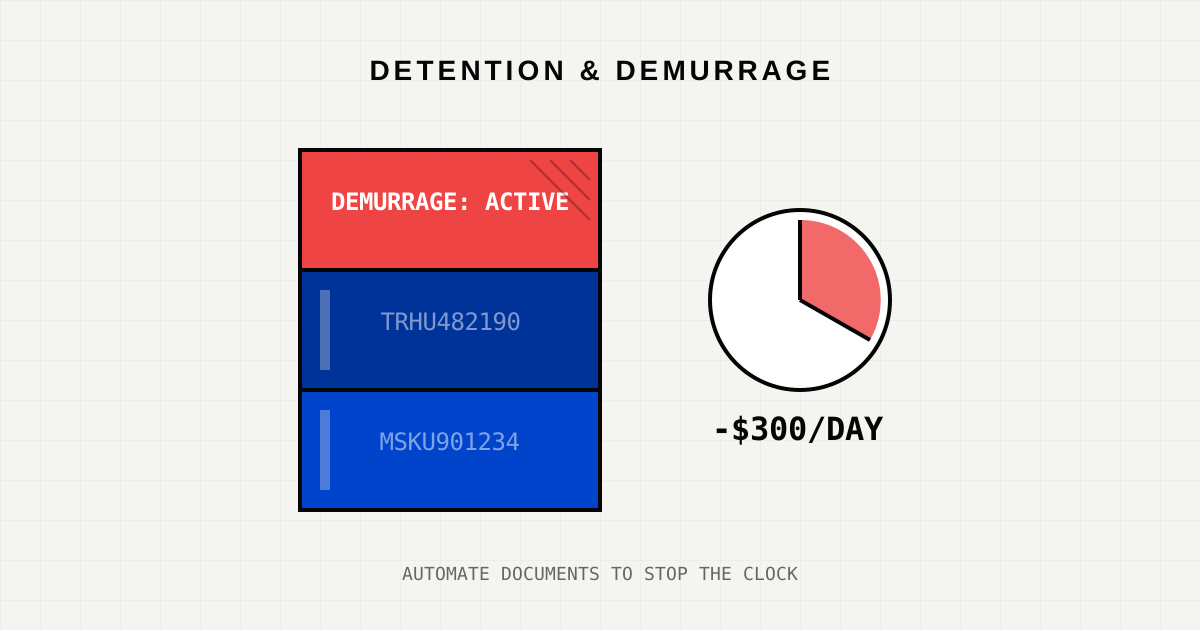
Global supply chains are running on tighter schedules than ever, yet one cost center continues to bleed profit margins: Detention and Demurrage (D&D) fees.
These charges, levied when containers linger too long at terminals (demurrage) or outside of them (detention), have skyrocketed in recent years. In major ports like Long Beach or Rotterdam, a single day of delay can cost $150 to $300 per container. For a freight forwarder managing hundreds of shipments, this is not a rounding error—it’s a crisis.
The tragedy of D&D fees is that they are almost entirely preventable. They usually aren’t caused by a lack of trucks or drivers, but by a lack of information.
Why do containers sit? Often, the physical box is ready to move, but the digital paperwork is stuck.
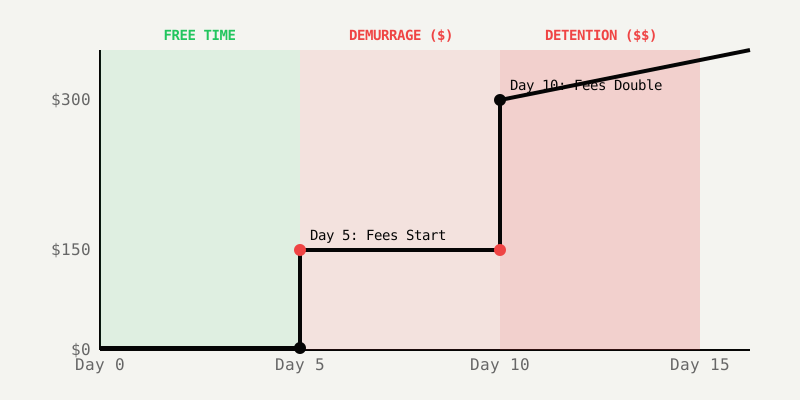
As the chart above illustrates, costs are binary. You incur $0 for the first 5-7 days (Free Time). But the moment the clock strikes midnight on Day 8, you are hit with penalties that compound daily.
The root problem is that logistics documents are unstructured data. Arrival Notices, Bills of Lading, and Commercial Invoices come as PDFs, scanned images, or Excel blobs.
Standard OCR tools struggle here. They see “text,” not “logistics data.” They cannot distinguish between a Master Bill of Lading number and a House Bill of Lading number. They choke on table headers that vary slightly between carriers (e.g., “Last Free Day” vs. “LFD” vs. “Demurrage Cutoff”).
This requires a human to act as a “middleware,” reading the PDF and typing data into the TMS (Transportation Management System). Humans are slow, expensive, and they sleep at night. Supply chains do not.
To stop the clock, you need to remove the human loop from the initial data capture.
LeapOCR treats these documents not as images, but as structured payloads. By using specialized models trained on logistics documentation, we can automate the “Release Order” workflow from end-to-end.
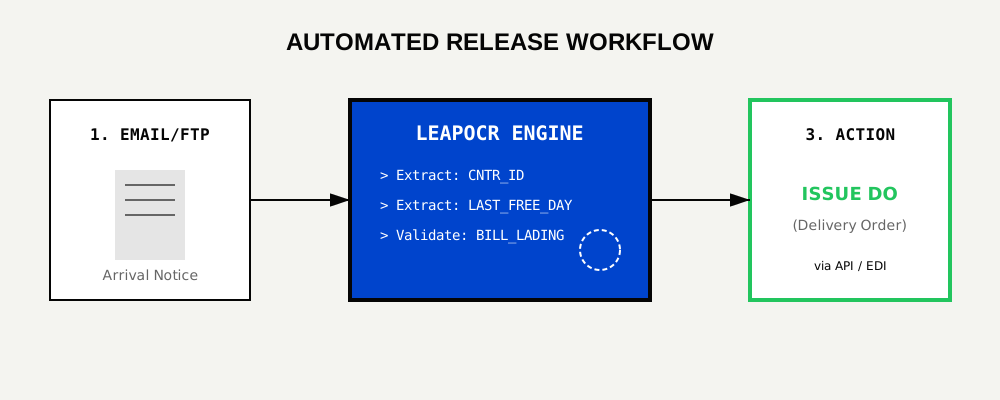
Instead of a human monitoring imports@logistics.com, LeapOCR monitors the inbox via API. When an Arrival Notice lands at 2:00 AM on a Sunday, it is processed immediately.
The engine looks for critical identifiers and dates:
MSKU901234)This is where automation pays for itself. The system doesn’t just extract data; it reasons with it.
“If
Last Free Dayis < 24 hours, flag as URGENT and alert the dispatch team immediately.”
This turns a passive list of emails into an active, prioritized dashboard.
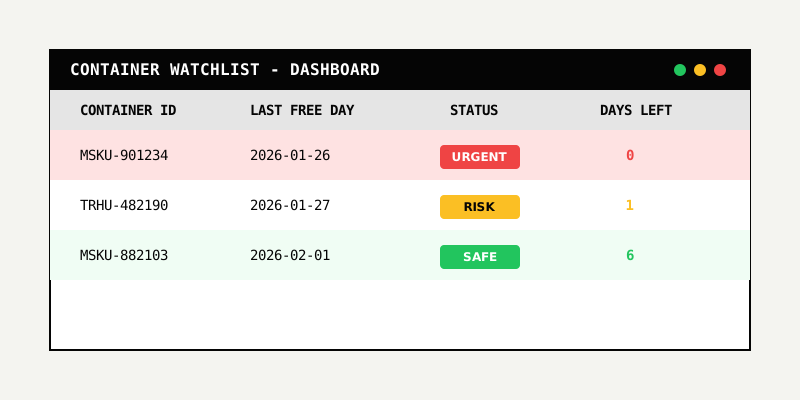
Let’s do the math on a mid-sized freight forwarder handling 500 containers a month.
Manual Process Cost: 50 containers _ 3 days _ $200 = $30,000 / month in preventable fees.
Automated Process: By processing documents instantly 24/7, you gain back 12-24 hours of lead time per shipment. If this reduces incidents by even 50%, you save $15,000/month strictly on penalties—before accounting for the labor savings of not typing data manually.
LeapOCR is designed to be headless. You don’t log into a new tool; we push data directly into your existing Transport Management System (like CargoWise, Magaya, or custom SQL databases).
In 2026, paying detention fees because an email sat unread is no longer a cost of doing business—it’s a choice.
By automating the “boring” work of document processing, you buy your operations team the one commodity they can’t get enough of: Time.
Ready to calculate your savings? See how the Logistics Document API works or try extracting an Arrival Notice today.
Try LeapOCR on your own documents
Eligible paid plans include a 3-day trial with 100 credits after you add a credit card, so you can test actual PDFs, scans, and forms before committing to a rollout.
Keep reading
More implementation guides, benchmarks, and workflow notes for teams building document pipelines.
How to use AI to untangle the messy, paper-heavy world of global supply chain documentation.
Robotic Process Automation (RPA) was a bridge technology. Learn why flexible Vision Language Models (VLM) are replacing brittle scripts in modern supply chains.
The warehouse receipt is the moment of truth for inventory. Learn how converting these documents into real-time structured data feeds eliminates shortage claims and speeds up order fulfillment.