Published
January 18, 2025
A meta-post on the content strategy itself, targeting users interested in the business side of the ESG automation pivot.

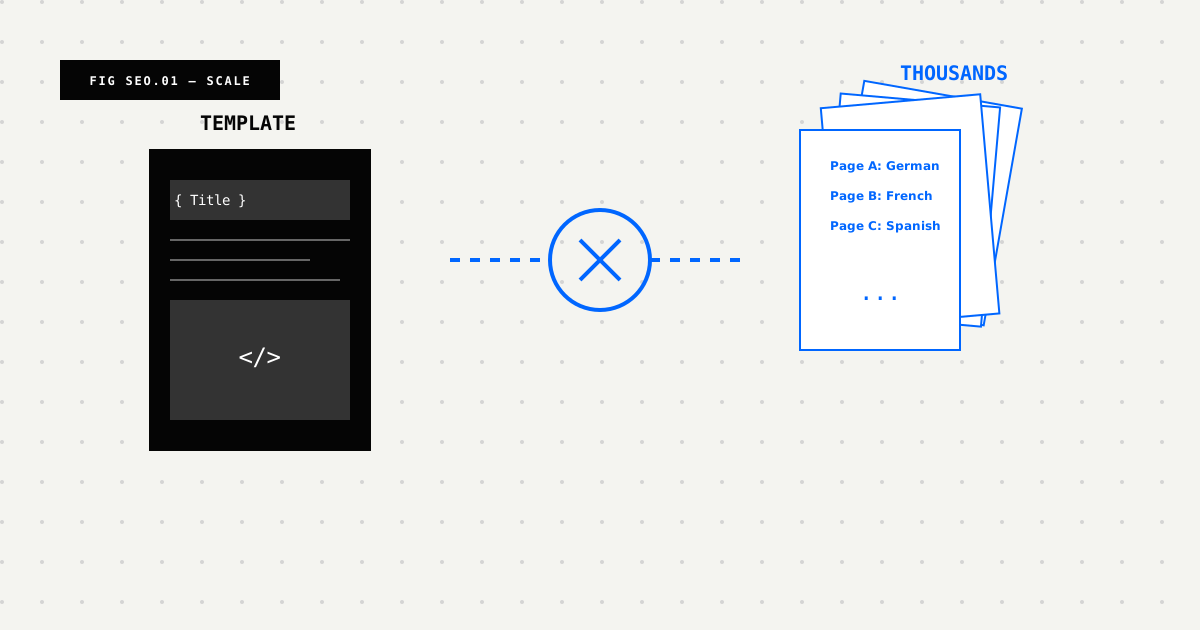
You’re building an ESG data automation platform. The technology works, but there’s a content problem: your SEO team is overwhelmed.
You need to cover 50+ document types across 24+ languages, targeting thousands of specific search queries like “CSRD compliance electricity bill extraction Germany.” Meanwhile, competitors have spent years publishing content. Writing pages manually won’t scale.
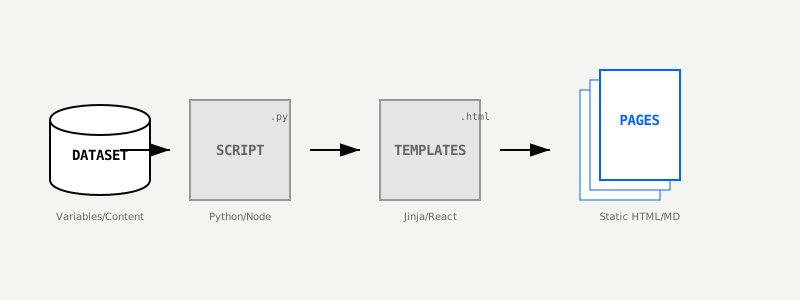
This is where programmatic SEO helps. Instead of writing each page individually, you build templates and generate pages at scale.
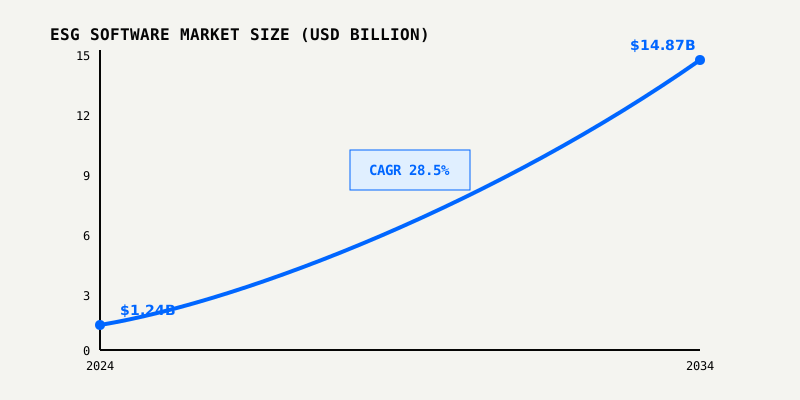
Given that the ESG software market is growing from $1.24 billion to $14.87 billion by 2034, let’s walk through how to build a document library that captures this organic traffic opportunity.
Traditional SEO means writing one blog post per topic. If you want 10 posts, a writer spends months creating them. This approach doesn’t scale beyond dozens of topics.
Programmatic SEO creates templates and generates pages at scale. One template applied to 50 document types produces 50 pages. That same template adapted for 10 languages creates 500 pages. It requires weeks of development and data preparation upfront, but scales to thousands of pages.
The key difference: programmatic SEO treats content like software. You build once and deploy everywhere.
The ESG data and reporting software market will grow from $1.24 billion in 2024 to $14.87 billion by 2034. That’s 12x growth with a 28.5% annual CAGR. The main drivers include regulations like CSRD (affecting 50,000 companies), SEC climate rules, and ISSB standards. ESG-focused investments are projected to reach $33.9 trillion by 2026.
This market growth shows up in search behavior:
ESG searches are specific. People aren’t searching for “ESG software” - they search for exact problems:
| Query Type | Example | Monthly Volume | Competition |
|---|---|---|---|
| Document-specific | ”extract data from German electricity bill PDF” | 800 | Low |
| Regulation-specific | ”CSRD ESRS E1 emissions data requirements” | 1,200 | Medium |
| Language-specific | ”utility bill OCR French German Italian” | 650 | Low |
| Industry-specific | ”automotive supplier Scope 3 data collection” | 950 | Low |
| Problem-specific | ”fix errors in ESG data manual entry” | 1,100 | Medium |
Together these long-tail keywords represent 50,000+ monthly searches with low competition.
First, identify the dimensions you’ll combine:
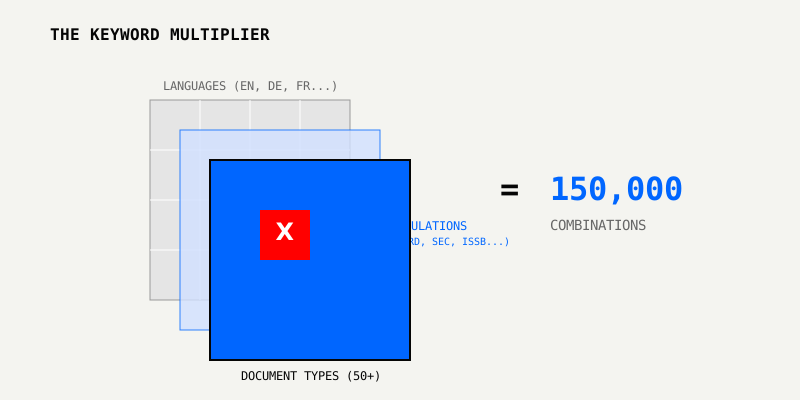
Next, build a keyword matrix. If you have 50 document types, 5 regulations, 10 industries, and 6 languages, that’s 150,000 potential combinations.
Finally, prioritize based on:
This process should leave you with 2,000-3,000 high-priority page targets.
You’ll need different templates for different page types. Here are four templates that work well for ESG:
URL pattern: /esg/documents/{document_type}
Each page includes:
Variables to insert: {document_type} (utility bill, supplier questionnaire, I-REC certificate), {emissions_scope} (Scope 1, 2, or 3), and {regulation} (CSRD, SEC climate rules).
Example: A page at /esg/documents/electricity-utility-bill would have the H1 “How to Automate Electricity Utility Bill Data Extraction for ESG” with content tailored to electricity bills in different languages.
URL pattern: /esg/compliance/{regulation}
Each page includes:
Example: /esg/compliance/CSRD would focus specifically on CSRD/ESRS requirements.
URL pattern: /esg/industries/{industry}
Each page includes:
Example: /esg/industries/automotive would focus on supply chain, Scope 3, and supplier data collection.
URL pattern: /esg/documents/{document_type}/{language}
Each page includes:
Example: /esg/documents/electricity-bill/german would cover German decimal formats, terminology, and examples for Stromrechnung.
CREATE TABLE programmatic_pages (
  id SERIAL PRIMARY KEY,
  page_type VARCHAR(50),  -- 'document', 'regulation', 'industry', 'language'
  template_slug VARCHAR(100),
  variables JSONB,  -- {"document_type": "utility_bill", "language": "de"}
  url_path VARCHAR(500),
  meta_title VARCHAR(200),
  meta_description VARCHAR(500),
  h1 VARCHAR(200),
  content JSONB,  -- Structured content blocks
  created_at TIMESTAMP DEFAULT NOW(),
  updated_at TIMESTAMP DEFAULT NOW(),
  published BOOLEAN DEFAULT false,
  UNIQUE(url_path)
);

CREATE TABLE page_variables (
  id SERIAL PRIMARY KEY,
  page_id INTEGER REFERENCES programmatic_pages(id),
  variable_name VARCHAR(50),
  variable_value VARCHAR(500),
  variable_type VARCHAR(20)  -- 'string', 'number', 'array'
);def generate_programmatic_page(page_type: str, variables: dict):
"""Generate programmatic SEO page from template."""
# Load template
template = load_template(f"templates/{page_type}.html")
# Load variable-specific content
content_data = load_content_data(page_type, variables)
# Merge template with variables
page_content = template.render(
document_type=variables.get("document_type"),
regulation=variables.get("regulation"),
industry=variables.get("industry"),
language=variables.get("language"),
**content_data
)
# Generate metadata
meta_title = generate_meta_title(page_type, variables)
meta_description = generate_meta_description(page_type, variables)
url_path = generate_url_path(page_type, variables)
# Save to database
page = {
"page_type": page_type,
"template_slug": f"{page_type}_template",
"variables": variables,
"url_path": url_path,
"meta_title": meta_title,
"meta_description": meta_description,
"h1": content_data["h1"],
"content": page_content,
"published": True
}
save_page(page)
return page
# Example: Generate all document type pages
document_types = [
"electricity-utility-bill",
"gas-utility-bill",
"supplier-emissions-questionnaire",
"irec-certificate",
# ... 50 more
]
for doc_type in document_types:
generate_programmatic_page("document", {"document_type": doc_type})def generate_programmatic_sitemap():
"""Generate sitemap for all programmatic pages."""
pages = query_all_published_pages()
sitemap = '<?xml version="1.0" encoding="UTF-8"?>'
sitemap += '<urlset xmlns="http://www.sitemaps.org/schemas/sitemap/0.9">'
for page in pages:
sitemap += f"""
<url>
<loc>https://leapocr.com{page['url_path']}</loc>
<lastmod>{page['updated_at'].strftime('%Y-%m-%d')}</lastmod>
<changefreq>weekly</changefreq>
<priority>0.7</priority>
</url>
"""
sitemap += '</urlset>'
return sitemapNot all pages need the same level of attention. Use a tiered approach:
Tier 1: High-Priority Pages (100 pages, 5%)
These pages target the top 100 keywords by volume with high commercial intent and competition. Have a human writer edit and enhance the programmatic draft, adding unique examples, case studies, and quotes. Optimize these for featured snippets.
Tier 2: Medium-Priority Pages (500 pages, 25%)
These pages target keywords with 500-2,000 monthly searches and medium competition. A human reviewer should check for factual accuracy, template variable errors, broken links, and grammar issues.
Tier 3: Long-Tail Pages (1,400 pages, 70%)
These pages target keywords with 100-500 monthly searches and low competition. Fully automate generation with QA checks that verify template variables are filled correctly, internal links work, metadata is present, and there’s no duplicate content.
Track these metrics to evaluate performance:
| Metric | 6-Month Target | 12-Month Target |
|---|---|---|
| Pages indexed | 1,000 | 2,000 |
| Organic traffic | 15,000/month | 50,000/month |
| Keyword rankings | 500 in top 10 | 2,000 in top 10 |
| Lead generation | 500 SQLs/month | 2,000 SQLs/month |
| Conversion rate | 2.5% | 3.5% |
Tools to use:
Don’t create doorway pages. Thin, low-value pages created just for SEO will hurt your rankings. Every page should provide genuine value with unique insights, examples, and code.
Watch out for duplicate content. If you generate 500 pages with 90% identical content, search engines will penalize you. Use canonical tags, vary content significantly between pages, and add unique elements to each.
Avoid keyword stuffing. Don’t repeat keywords unnaturally. Write for humans first, search engines second.
Don’t neglect user experience. Fast loading, mobile-friendly design, clear navigation, and valuable content matter more than SEO tricks.
Don’t skip content review. Even programmatic pages need oversight. Use the tiered review process described above, continuously improve based on performance data, and gather user feedback.
One ESG data platform (anonymous) implemented programmatic SEO over 6 months with a $75,000 investment in development and content.
Before:
After:
ROI: 29x return on investment in the first year.
What made it work:
A 90-day timeline works well:
Month 1: Foundation
Month 2: Generation
Month 3: Optimization
Month 4 and beyond:
Programmatic SEO doesn’t replace content marketers—it scales their impact. By treating content like software and building reusable templates, you can:
The ESG software market is growing 28.5% annually. Programmatic SEO helps you capture this growth efficiently at scale.
Your next customer is searching for a specific ESG document solution. Make sure they find you.
Next Steps:
Try LeapOCR on your own documents
Eligible paid plans include a 3-day trial with 100 credits after you add a credit card, so you can test actual PDFs, scans, and forms before committing to a rollout.
Keep reading
More implementation guides, benchmarks, and workflow notes for teams building document pipelines.

A practical comparison of AI OCR and template-based parser tools, with guidance on where each one fits and where each one breaks.
A practical comparison of bank statement OCR and PDF parser tools, with emphasis on transaction rows, balances, and downstream fit.

An honest look at the strongest bank statement OCR APIs and parser-style alternatives, with a focus on transaction rows, balances, and downstream workflow fit.