Published
January 18, 2025
Technical deep dive on using JSON Schema to enforce data quality and consistency for regulatory filings.

Your sustainability team spent six months collecting ESG data. Two days before your CSRD filing deadline, you discover:
These inconsistencies invalidate your entire submission. External auditors will reject it, you’ll miss the deadline, and investors will have questions.
JSON Schema validation prevents this by enforcing data quality and consistency when data enters your systems, rather than discovering problems months later.
The cost of inadequate data validation is substantial. Companies face audit failures, regulatory penalties, and restatement costs averaging €45,000 per incident. In 2023, 12% of EU companies restated ESG data due to validation errors.
JSON Schema defines the structure, types, and validation rules for JSON data. Think of it as a contract that data must satisfy to be accepted.
Here’s a simple example:
{
  "type": "object",
  "properties": {
    "energy_consumption_kwh": {
      "type": "number",
      "minimum": 0
    }
  },
  "required": ["energy_consumption_kwh"]
}
This schema requires that energy_consumption_kwh must exist, must be a number, and cannot be negative.
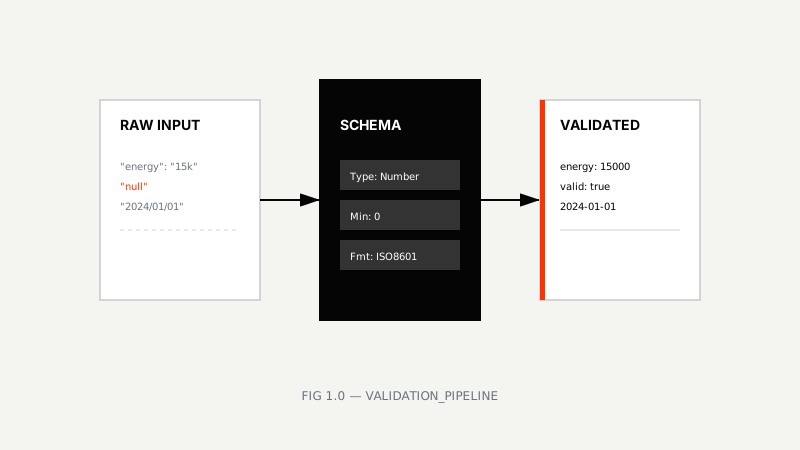 FIG 1.0 — JSON Schema validation flow ensuring data quality and compliance
Type mismatches cause calculation errors. JSON Schema catches these early:
Identify impossible values before they propagate:
Require all mandatory fields:
Standardize data across facilities and suppliers:
Encode ESRS/CSRD requirements directly in your schema:
Research from the OntoMetric framework shows JSON Schema validation achieves 80-90% schema compliance and 65-90% semantic accuracy for complex ESG documents. Traditional extraction methods typically achieve only 3-10% accuracy. DataHen reports that validating at every pipeline stage catches errors early and increases efficiency through automation.
{
"$schema": "http://json-schema.org/draft-07/schema#",
"title": "Utility Bill ESG Data",
"description": "Schema for extracting electricity, gas, and water utility bill data for CSRD compliance",
"type": "object",
"properties": {
"document_type": {
"description": "Type of utility bill",
"type": "string",
"enum": ["electricity", "gas", "water", "district_heating"]
},
"facility_id": {
"description": "Unique facility identifier",
"type": "string",
"pattern": "^[A-Z]{3}-[0-9]{2,3}$", // Enforces format: MUC-01, LON-12
"minLength": 5,
"maxLength": 20
},
"supplier": {
"description": "Utility supplier name",
"type": "string",
"minLength": 2
},
"account_number": {
"description": "Supplier account number",
"type": "string",
"pattern": "^[A-Z0-9-]+$" // Alphanumeric with hyphens
},
"billing_period": {
"description": "Billing period",
"type": "object",
"properties": {
"start_date": {
"description": "Billing period start date (ISO 8601)",
"type": "string",
"format": "date"
},
"end_date": {
"description": "Billing period end date (ISO 8601)",
"type": "string",
"format": "date"
}
},
"required": ["start_date", "end_date"]
},
"energy_consumption": {
"description": "Energy consumption data",
"type": "object",
"properties": {
"kwh": {
"description": "Consumption in kilowatt-hours",
"type": "number",
"minimum": 0,
"exclusiveMaximum": 10000000 // Max 10M kWh per month
},
"mwh": {
"description": "Consumption in megawatt-hours (alternative unit)",
"type": "number",
"minimum": 0,
"exclusiveMaximum": 10000
}
},
"oneOf": [{ "required": ["kwh"] }, { "required": ["mwh"] }]
},
"renewable_energy": {
"description": "Renewable energy breakdown",
"type": "object",
"properties": {
"kwh": {
"description": "Renewable consumption in kWh",
"type": "number",
"minimum": 0
},
"percentage": {
"description": "Renewable energy percentage (0-100)",
"type": "number",
"minimum": 0,
"maximum": 100
},
"source": {
"description": "Renewable energy source",
"type": "string",
"enum": ["solar", "wind", "hydro", "biomass", "geothermal", "mixed", "unknown"]
}
}
},
"total_cost": {
"description": "Total bill amount",
"type": "object",
"properties": {
"amount": {
"description": "Cost amount",
"type": "number",
"minimum": 0
},
"currency": {
"description": "Currency code (ISO 4217)",
"type": "string",
"pattern": "^[A-Z]{3}$", // 3-letter ISO currency code
"enum": ["EUR", "GBP", "USD", "CHF", "SEK", "NOK", "DKK", "PLN"]
}
},
"required": ["amount", "currency"]
}
},
"required": ["document_type", "facility_id", "billing_period", "energy_consumption"]
}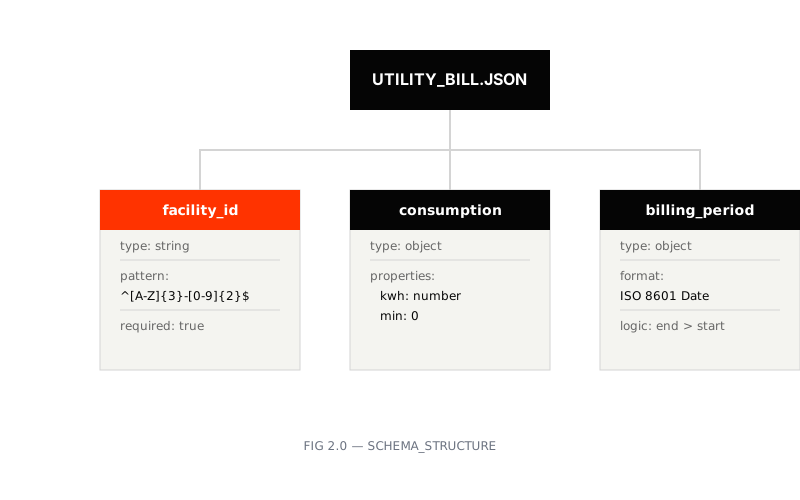 FIG 2.0 — Structure of a CSRD-compliant utility bill schema
{
  "$schema": "http://json-schema.org/draft-07/schema#",
  "title": "Supplier Emissions Data (Scope 3 Category 1)",
  "description": "Schema for supplier emissions data for CSRD Scope 3 reporting",
  "type": "object",
  "properties": {
    "supplier_id": {
      "description": "Unique supplier identifier",
      "type": "string",
      "pattern": "^SUP-[0-9]{4}$" // Enforces format: SUP-0001
    },
    "supplier_name": {
      "description": "Supplier legal name",
      "type": "string",
      "minLength": 2
    },
    "reporting_year": {
      "description": "Reporting year",
      "type": "integer",
      "minimum": 2020,
      "maximum": 2030 // Future-proof to 2030
    },
    "emissions": {
      "description": "Greenhouse gas emissions",
      "type": "object",
      "properties": {
        "scope1_tco2e": {
          "description": "Scope 1 emissions in metric tonnes CO2e",
          "type": "number",
          "minimum": 0
        },
        "scope2_tco2e": {
          "description": "Scope 2 emissions in metric tonnes CO2e",
          "type": "number",
          "minimum": 0
        },
        "scope3_tco2e": {
          "description": "Scope 3 emissions in metric tonnes CO2e",
          "type": "number",
          "minimum": 0
        },
        "total_tco2e": {
          "description": "Total emissions (Scope 1+2+3)",
          "type": "number",
          "minimum": 0
        }
      },
      "required": ["scope1_tco2e", "scope2_tco2e"]
    },
    "methodology": {
      "description": "Calculation methodology",
      "type": "string",
      "enum": [
        "GHG Protocol",
        "ISO 14064",
        "ISO 14067",
        "Spend-based",
        "Average-data",
        "Hybrid",
        "Custom"
      ]
    },
    "verification": {
      "description": "Third-party verification status",
      "type": "object",
      "properties": {
        "status": {
          "description": "Verification status",
          "type": "string",
          "enum": ["Third-party verified", "Self-assessed", "Not verified", "Partial"]
        },
        "verifier": {
          "description": "Verification organization name",
          "type": "string"
        },
        "verification_date": {
          "description": "Verification date (ISO 8601)",
          "type": "string",
          "format": "date"
        },
        "assurance_level": {
          "description": "Assurance level (ISAE 3000/ISO 14064)",
          "type": "string",
          "enum": ["Reasonable Assurance", "Limited Assurance", "None"]
        }
      }
    },
    "data_coverage": {
      "description": "Data completeness and coverage",
      "type": "object",
      "properties": {
        "percentage": {
          "description": "Percentage of total spend/emissions covered",
          "type": "number",
          "minimum": 0,
          "maximum": 100
        },
        "exclusions": {
          "description": "Categories or facilities excluded from data",
          "type": "array",
          "items": {
            "type": "string"
          }
        },
        "estimation_method": {
          "description": "Method used for uncovered data",
          "type": "string",
          "enum": ["Industry average", "Spend-based proxy", "Extrapolation", "Not estimated"]
        }
      }
    }
  },
  "required": ["supplier_id", "reporting_year", "emissions", "methodology"]
}Require certain fields only when relevant:
{
  "type": "object",
  "properties": {
    "verification_status": {
      "type": "string",
      "enum": ["verified", "not_verified"]
    },
    "verifier_name": {
      "type": "string"
    },
    "verification_date": {
      "type": "string",
      "format": "date"
    }
  },
  "if": {
    "properties": {
      "verification_status": {
        "const": "verified"
      }
    }
  },
  "then": {
    "required": ["verifier_name", "verification_date"]
  }
}
If verification_status is “verified”, the schema requires verifier_name and verification_date. Otherwise, those fields are optional.
Ensure relationships between fields are valid:
{
  "type": "object",
  "properties": {
    "total_consumption_kwh": { "type": "number", "minimum": 0 },
    "renewable_consumption_kwh": { "type": "number", "minimum": 0 },
    "renewable_percentage": { "type": "number", "minimum": 0, "maximum": 100 }
  },
  "allOf": [
    {
      "if": {
        "properties": {
          "total_consumption_kwh": { "type": "number" },
          "renewable_consumption_kwh": { "type": "number" }
        },
        "required": ["total_consumption_kwh", "renewable_consumption_kwh"]
      },
      "then": {
        "properties": {
          "renewable_consumption_kwh": {
            "maximum": { "$data": "1/total_consumption_kwh" }
          }
        }
      }
    }
  ]
}
Cross-field validation often requires custom logic beyond standard JSON Schema. Implement this in application code:
def validate_consumption_totals(data: dict) -> bool:
  """Validate renewable doesn't exceed total."""
  total = data.get("total_consumption_kwh", 0)
  renewable = data.get("renewable_consumption_kwh", 0)

  if renewable > total:
    raise ValueError(f"Renewable consumption ({renewable}) cannot exceed total consumption ({total})")

return TrueEnforce consistent ID formats across facilities:
{
  "facility_id": {
    "type": "string",
    "pattern": "^[A-Z]{3}-[0-9]{2}$", // MUC-01, LON-12, BER-05
    "description": "Facility ID format: 3-letter city code, hyphen, 2-digit number"
  }
}
Valid: MUC-01, LON-12, BER-05 Invalid: MUC-1 (missing digit), Munich-01 (wrong format), muc-01 (lowercase)
Limit values to approved lists. This is useful for emission sources, methodologies, and other standardized fields:
{
  "emission_source": {
    "type": "string",
    "enum": [
      "stationary_combustion",
      "mobile_combustion",
      "process_emissions",
      "fugitive_emissions",
      "electricity_imported",
      "refrigerants",
      "other"
    ]
  }
}from leapocr import LeapOCR
# Define your schema
utility_bill_schema = {
# ... (full schema from Example 1 above)
}
# Create template with schema
template = {
"name": "esg-utility-bill-csrd",
"description": "Extract utility bill data for CSRD compliance with JSON Schema validation",
"format": "structured",
"schema": utility_bill_schema,
"instructions": """
Extract utility bill data with the following requirements:
- Facility ID must match pattern: XXX-## (e.g., MUC-01, LON-12)
- Dates must be in ISO 8601 format (YYYY-MM-DD)
- Energy consumption must be >= 0
- Renewable percentage must be 0-100
- Currency must be valid ISO 4217 code
If validation fails, flag the specific fields that don't meet schema requirements.
"""
}
# Create template via API
client = LeapOCR(api_key=os.getenv("LEAPOCR_API_KEY"))
created_template = client.templates.create(template)
print(f"Template created: {created_template['template_slug']}")# Process document with schema validation
job = client.ocr.process_file(
file_path="utility_bill.pdf",
format="structured",
template_slug="esg-utility-bill-csrd"
)
result = client.ocr.wait_until_done(job["job_id"])
if result["status"] == "completed":
data = result["pages"][0]["result"]
# Check if validation passed
if result["pages"][0].get("schema_valid", True):
print("✅ Schema validation passed")
print(f"Extracted data: {data}")
else:
print("❌ Schema validation failed")
print(f"Validation errors: {result['pages'][0].get('validation_errors', [])}")
else:
print(f"Extraction failed: {result.get('error')}")def handle_validation_errors(result: dict):
"""Handle schema validation errors gracefully."""
validation_errors = result["pages"][0].get("validation_errors", [])
if validation_errors:
print("Validation errors detected:")
for error in validation_errors:
field = error.get("field", "unknown")
message = error.get("message", "Invalid value")
value = error.get("value", "N/A")
print(f" - {field}: {message} (got: {value})")
# Flag for human review
flag_for_review(result["job_id"], field, message)
# Don't save invalid data to database
return False
else:
# Save valid data
save_to_database(result["pages"][0]["result"])
return Trueimport pytest
from jsonschema import validate, ValidationError
def test_valid_utility_bill():
"""Test that valid data passes schema validation."""
schema = load_schema("utility_bill.json")
valid_data = {
"document_type": "electricity",
"facility_id": "MUC-01",
"billing_period": {
"start_date": "2024-01-01",
"end_date": "2024-01-31"
},
"energy_consumption": {
"kwh": 45230
}
}
# Should not raise exception
validate(instance=valid_data, schema=schema)
def test_invalid_facility_id():
"""Test that invalid facility ID fails validation."""
schema = load_schema("utility_bill.json")
invalid_data = {
"document_type": "electricity",
"facility_id": "Munich-01", # Wrong format
"billing_period": {
"start_date": "2024-01-01",
"end_date": "2024-01-31"
},
"energy_consumption": {
"kwh": 45230
}
}
# Should raise ValidationError
with pytest.raises(ValidationError) as exc_info:
validate(instance=invalid_data, schema=schema)
assert "facility_id" in str(exc_info.value)
assert "pattern" in str(exc_info.value)
def test_negative_consumption():
"""Test that negative consumption fails validation."""
schema = load_schema("utility_bill.json")
invalid_data = {
"document_type": "electricity",
"facility_id": "MUC-01",
"billing_period": {
"start_date": "2024-01-01",
"end_date": "2024-01-31"
},
"energy_consumption": {
"kwh": -100 # Negative!
}
}
with pytest.raises(ValidationError) as exc_info:
validate(instance=invalid_data, schema=schema)
assert "minimum" in str(exc_info.value)def test_extraction_with_validation():
"""Test extraction pipeline with schema validation."""
# Process real utility bill
job = client.ocr.process_file(
file_path="test_data/sample_bill.pdf",
format="structured",
template_slug="esg-utility-bill-csrd"
)
result = client.ocr.wait_until_done(job["job_id"])
# Assert extraction succeeded
assert result["status"] == "completed"
# Assert schema validation passed
assert result["pages"][0].get("schema_valid", True) == True
# Assert required fields are present
data = result["pages"][0]["result"]
assert "facility_id" in data
assert "energy_consumption" in data
assert "billing_period" in data
# Assert data types are correct
assert isinstance(data["energy_consumption"]["kwh"], (int, float))
assert data["energy_consumption"]["kwh"] >= 0Ensure start dates come before end dates:
{
  "reporting_period": {
    "type": "object",
    "properties": {
      "start_date": { "type": "string", "format": "date" },
      "end_date": { "type": "string", "format": "date" }
    },
    "required": ["start_date", "end_date"]
  }
}
Add application-layer validation for date logic:
def validate_date_range(data: dict):
  """Ensure start_date <= end_date."""
  start = data.get("reporting_period", {}).get("start_date")
  end = data.get("reporting_period", {}).get("end_date")

  if start and end:
    if datetime.fromisoformat(start) > datetime.fromisoformat(end):
raise ValueError(f"Start date ({start}) cannot be after end date ({end})")Keep percentages within valid bounds:
{
  "renewable_percentage": {
    "type": "number",
    "minimum": 0,
    "maximum": 100
  }
}Require exactly one unit type:
{
  "energy_consumption": {
    "type": "object",
    "oneOf": [{ "required": ["kwh"] }, { "required": ["mwh"] }],
    "properties": {
      "kwh": { "type": "number", "minimum": 0 },
      "mwh": { "type": "number", "minimum": 0 }
    }
  }
}
This enforces that either kWh OR MWh must be present, but not both or neither.
Accept only valid currency codes:
{
  "currency": {
    "type": "string",
    "pattern": "^[A-Z]{3}$",
    "enum": ["EUR", "GBP", "USD", "CHF", "SEK", "NOK", "DKK", "PLN"]
  }
}Encode ESRS data requirements in your schema:
Log every validation attempt for audit purposes:
{
  "validation_attempt": {
    "timestamp": "2024-02-01T14:23:11Z",
    "schema_version": "1.2.0",
    "result": "failed",
    "errors": [
      {
        "field": "renewable_percentage",
        "error": "maximum",
        "message": "Value 120 exceeds maximum 100",
        "value": 120
      }
    ]
  }
}Run automated validation checks regularly:
# Run nightly validation on all ESG data
def nightly_validation_check():
  """Validate all ESG data in database."""
  cursor.execute("SELECT * FROM esg_data WHERE validation_status != 'validated'")

  for row in cursor.fetchall():
    data = json.loads(row["data"])
    schema = load_schema(row["data_type"])

    try:
      validate(instance=data, schema=schema)
      cursor.execute("UPDATE esg_data SET validation_status = 'validated' WHERE id = %s", (row["id"],))
    except ValidationError as e:
      cursor.execute(
        "UPDATE esg_data SET validation_status = 'failed', validation_error = %s WHERE id = %s",
        (str(e), row["id"])
)JSON Schema validation prevents data quality problems before they become compliance issues. By enforcing type safety, range constraints, and format consistency at extraction time, you:
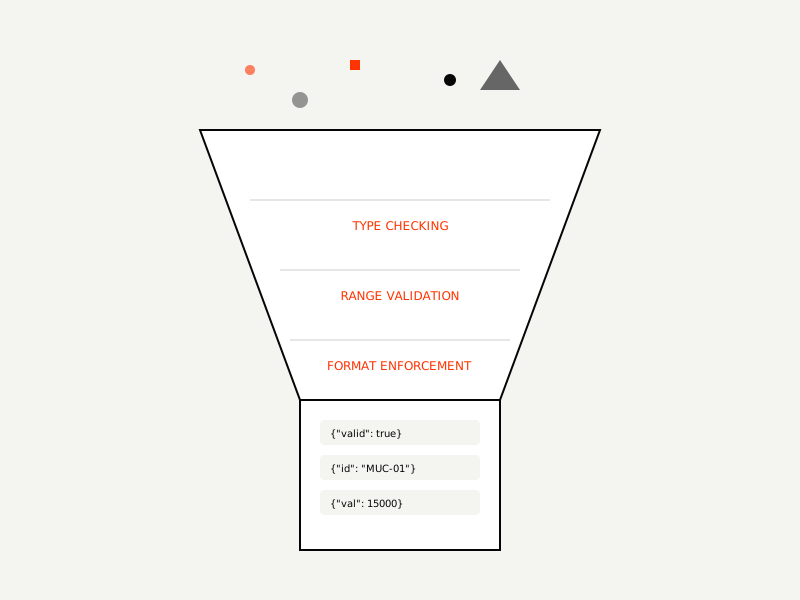 FIG 3.0 — The data quality funnel: from raw input to audit-ready output
Your sustainability data is only as reliable as your validation. Build schemas that enforce quality from the start.
Next Steps:
Try LeapOCR on your own documents
Eligible paid plans include a 3-day trial with 100 credits after you add a credit card, so you can test actual PDFs, scans, and forms before committing to a rollout.
Keep reading
More implementation guides, benchmarks, and workflow notes for teams building document pipelines.

New competitor benchmarks reveal why humans average 1.6% error rates per invoice compared to LeapOCR's 99%+ accuracy.

CSRD isn't just about compliance; it's a data engineering problem. Here is how to build an automated pipeline that turns scattered PDFs into audit-ready JSON.

Discussion of GDPR and other data sovereignty requirements for ESG data. LeapOCR's compliance features and air-gapped options.