Published
January 18, 2025
Discussion of GDPR and other data sovereignty requirements for ESG data. LeapOCR's compliance features and air-gapped options.
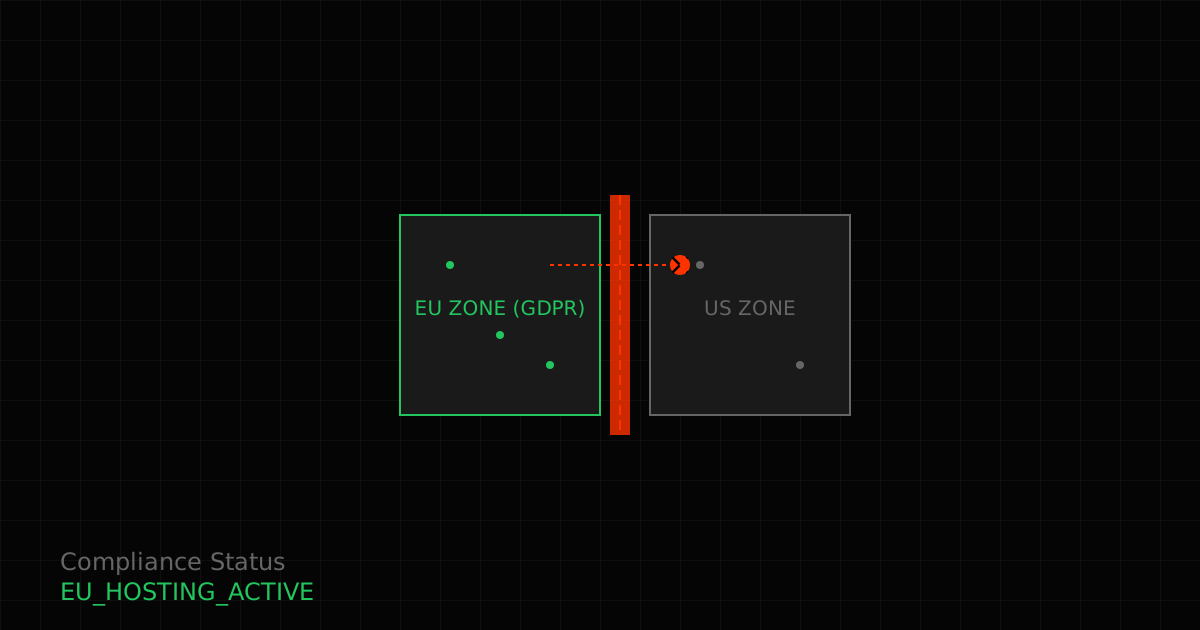
Your CSRD reporting team just finished uploading 10,000 supplier emissions documents to a US-based AI platform. Three months later, your data protection officer sends an urgent email: the platform has been processing personal data—supplier contacts, employee travel records—and sensitive business information outside the EEA. This violates GDPR and your internal data sovereignty policy.
This scenario plays out more often than you’d expect. As ESG reporting shifts to digital systems under CSRD, SEC, and ISSB, data residency has moved from a technical footnote to a central compliance concern.
This guide covers why EU hosting matters for ESG data, which regulations you need to consider, and what options are available for compliant processing.
Data Residency refers to where data is physically stored and processed. Data Sovereignty refers to the laws that govern that data based on its location.
Here’s why this matters: if your data is stored in the United States, it’s subject to US laws. The CLOUD Act, for example, allows US law enforcement to access data from US-based service providers, even when that data belongs to EU companies.
The regulatory landscape has shifted significantly:
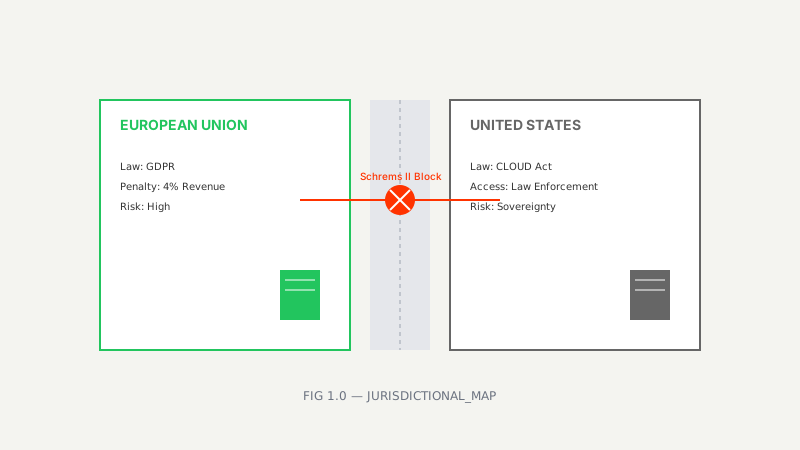 FIG 1.0 — Data residency requirements for EU and US regions with GDPR and CLOUD Act considerations
ESG documents contain several types of regulated data, each with its own compliance requirements:
| Data Type | Example | Regulation | Risk if Violated |
|---|---|---|---|
| Personal Data | Employee names, addresses, travel records | GDPR | Up to €20M or 4% global revenue |
| Business Sensitive | Proprietary emissions, trade secrets | Trade secrets laws | Competitive disadvantage |
| Financial Data | Energy costs, carbon pricing, fines | Accounting standards | Misstatement, regulatory penalties |
| Third-Party Data | Supplier emissions, contractor data | Third-party contracts | Contractual breaches, lawsuits |
Consider a utility bill. It contains the account holder’s name and address (personal data protected by GDPR), consumption patterns that reveal production volumes (business-sensitive information), and cost structures that competitors could use to reverse-engineer pricing (financial data).
GDPR applies to all personal data of EU residents, regardless of where it’s processed. Currently, 144 countries have enacted data privacy laws covering 79% of the global population. For serious violations, GDPR fines can reach up to 4% of global annual revenue.
When processing ESG data, GDPR requires:
A common violation pattern: uploading supplier contacts (names, emails) to a US-based platform that processes data outside the EEA without adequate safeguards. The penalty for this can reach €20 million or 4% of global annual revenue.
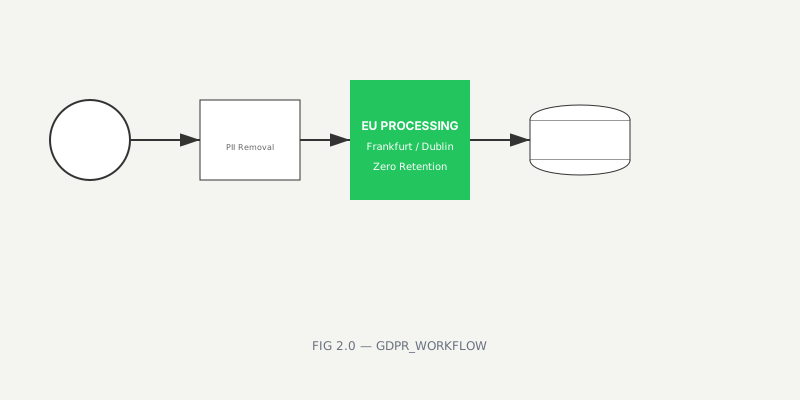 FIG 2.0 — GDPR compliance flow for ESG data processing with lawful basis and data protection measures
CSRD doesn’t explicitly require EU hosting for ESRS data. However, since most ESG reports contain personal data, GDPR still applies. Additionally, national data protection authorities like France’s CNIL or Germany’s BfDI may impose stricter requirements.
In practice, most EU companies choose EU-hosted platforms for CSRD data to avoid the complexity of GDPR transfer mechanisms.
The SEC requires disclosure of Scope 1 and 2 emissions for US companies and foreign private issuers. This creates a conflict for multinational companies: a German subsidiary of a US parent must report to the SEC under US rules while maintaining GDPR compliance.
The solution is to use EU-hosted platforms that can export data to the US using GDPR-compliant transfer mechanisms like Standard Contractual Clauses or adequacy decisions.
Some EU countries have stricter than GDPR requirements:
| Country | Stricter Requirements | ESG Impact |
|---|---|---|
| France | Health data requires explicit consent | Employee commuting data (Category 7) |
| Germany | Works council approval for employee monitoring | Employee travel, commuting data |
| Netherlands | Trade secrets protection | Proprietary emissions data |
The US CLOUD Act (2018) allows US law enforcement to compel US-based service providers to produce data, regardless of where that data is stored. This applies even to EU subsidiaries of US companies.
Here’s the problem: Your EU company uses a US-based ESG platform. Even if your data is stored in EU data centers to comply with GDPR, US law enforcement can serve a warrant to the US parent company. The company must comply, even if providing that data violates EU law.
When EU companies comply with US warrants, they may simultaneously violate GDPR, which prohibits data transfers without adequate safeguards.
The Schrems II decision (2020) invalidated the Privacy Shield framework, making US-to-EU data transfers more complex. Standard Contractual Clauses between EU companies and US platforms now require:
Processing ESG data on US platforms has become legally complex and risky for EU companies. With 79% of the global population covered by data privacy laws across 144 countries, organizations must navigate an increasingly complicated compliance landscape.
LeapOCR’s infrastructure is designed for EU compliance:
The data flow works like this:
┌─────────────────┐
│  Your Company   │
│  (EU-based)     │
└────────┬────────┘
         │
         ▼ (Upload)
┌─────────────────┐
│  LeapOCR API    │
│  (EU-hosted)    │  ← Processed in EU, subject to EU laws
└────────┬────────┘
         │
         ▼ (Results)
┌─────────────────┐
│  Your Database  │
│  (EU-hosted)    │  ← Data never leaves EU
└─────────────────┘LeapOCR’s default retention period is 7 days, configurable down to 0 days. After processing completes, data is deleted immediately. We don’t use your data to train our models, and we don’t share it with third parties.
Here’s how it works:
# Process with zero retention
job = client.ocr.process_file(
  file_path="utility_bill.pdf",
  format="structured",
  retention_days=0  # Delete immediately after processing
)

result = client.ocr.wait_until_done(job["job_id"])

# At this point, data is already deleted from LeapOCR servers
# You have the extracted JSON, but we don't retain the original
Since there’s no “data at rest” in our systems, the GDPR impact is minimal.
For highly sensitive ESG data—defense contractors or critical infrastructure, for example—LeapOCR offers on-premise deployment. The system runs in your private cloud (AWS EU Frankfurt, Azure EU regions), so your data never leaves your infrastructure. You maintain full control over access, logging, and retention while still benefiting from our AI models through containerized deployment.
You can also use a hybrid approach: process sensitive data like Scope 3 supplier emissions on-premise, while routing non-sensitive data like public utility bills through the cloud API.
LeapOCR provides granular access controls:
Here’s an example of setting up restricted access:
# Set up team with restricted access
client.teams.create_member({
  "email": "analyst@yourcompany.com",
  "role": "analyst",
  "permissions": ["view_documents", "view_results"],
  "restrictions": ["no_download_originals"]  # Can't download source PDFs
})When an individual requests data deletion under GDPR, you can remove all their data:
# Delete all documents associated with an email address
client.ocr.delete_by_metadata({
  "uploader_email": "former_employee@yourcompany.com"
})

# Generates deletion report for GDPR compliance
{
  "deleted_documents": 47,
  "deleted_jobs": 47,
  "deletion_timestamp": "2024-02-01T14:23:11Z",
  "compliance_reference": "GDPR-ART17-2024-001"
}LeapOCR’s DPA covers:
The DPA is automatically included in Business and Enterprise plans.
LeapOCR holds ISO 27001 certification covering document processing, data extraction, and API services. The certification covers our EU infrastructure and processes, with annual surveillance audits by independent third-party auditors (DNV, Bureau Veritas).
This certification demonstrates the “appropriate security measures” required under GDPR Article 32.
Start by classifying your ESG documents by sensitivity level:
| Classification | Example | Processing Location | Access Level |
|---|---|---|---|
| Public | Public utility tariffs, emission factors | Cloud API | All team members |
| Internal | Energy consumption, emissions data | Cloud API (with retention) | Analysts + managers |
| Confidential | Supplier emissions, trade secrets | On-premise or zero-retention | Authorized analysts only |
| Restricted | Employee data, personal information | On-premise + encryption | Named individuals only |
Before uploading documents, redact personal data:
import redactor

# Redact personal data before processing
def prepare_esg_document(file_path: str) -> str:
  """Redact personal data from ESG documents."""
  # Load document
  doc = load_pdf(file_path)

  # Redact personal data patterns
  doc = redactor.redact_emails(doc)
  doc = redactor.redact_phone_numbers(doc)
  doc = redactor.redact_addresses(doc)
  doc = redactor.redact_names(doc)  # ML-based name detection

  # Save redacted version
  redacted_path = file_path.replace(".pdf", "_redacted.pdf")
  doc.save(redacted_path)

  return redacted_path

# Process redacted version
redacted_file = prepare_esg_document("utility_bill.pdf")
job = client.ocr.process_file(redacted_file)Set appropriate retention periods for each data type:
# Public data (e.g., emission factors): 30-day retention
public_job = client.ocr.process_file(
  file_path="emission_factors.pdf",
  retention_days=30
)

# Internal data (e.g., consumption data): 7-day retention
internal_job = client.ocr.process_file(
  file_path="utility_bill.pdf",
  retention_days=7
)

# Confidential data (e.g., supplier emissions): 0-day retention
confidential_job = client.ocr.process_file(
  file_path="supplier_emissions.pdf",
  retention_days=0
)Create teams based on sensitivity levels:
# Create teams by sensitivity level
client.teams.create({
  "name": "ESG Public Data",
  "permissions": ["view", "download"],
  "members": ["analyst@yourcompany.com", "manager@yourcompany.com"]
})

client.teams.create({
  "name": "ESG Confidential",
  "permissions": ["view"],  # No download
  "members": ["senior_analyst@yourcompany.com"],
  "approval_required": True  # Manager approval to access
})Generate regular compliance reports for auditors:
# Monthly GDPR compliance report
def generate_compliance_report():
  """Generate GDPR compliance report for auditor."""
  report = {
    "report_period": "2024-01-01 to 2024-01-31",
    "documents_processed": count_documents(),
    "data_classification": {
      "public": count_by_classification("public"),
      "internal": count_by_classification("internal"),
      "confidential": count_by_classification("confidential")
    },
    "retention_compliance": {
      "zero_day": count_by_retention(0),
      "seven_day": count_by_retention(7),
      "thirty_day": count_by_retention(30)
    },
    "data_transfers": {
      "eu_to_eu": count_by_region("eu", "eu"),
      "eu_to_non_eu": 0  # Should be zero!
    },
    "data_subject_requests": {
      "access_requests": 3,
      "deletion_requests": 1,
      "average_resolution_time_days": 5
    },
    "security_incidents": 0
  }

return reportPros:
Cons:
Best for: EU companies subject to CSRD, GDPR, and EU data sovereignty requirements.
Pros:
Cons:
Best for: US companies with no EU operations or GDPR exposure.
Pros:
Cons:
Best for: Multinational companies with operations in EU and US.
A German manufacturer faces three challenges: CSRD and GDPR compliance, strict works council data protection requirements, and suppliers who refuse to send data to US platforms.
The company implemented LeapOCR’s EU-hosted solution with zero retention policy and on-premise deployment for supplier emissions. After putting DPAs in place with all suppliers, the company achieved GDPR compliance and works council approval. Supplier participation increased by 40% once they knew data would remain in the EU.
A French parent company must comply with CSRD and GDPR, while its US subsidiary needs to follow SEC climate rules. Sharing data between entities without violating GDPR creates complexity.
The solution: The French parent uses LeapOCR EU-hosted for CSRD data, while the US subsidiary uses a separate LeapOCR deployment for SEC data. Data exports from EU to US use SCCs with TIA documentation, and anonymization techniques protect personal information during cross-border transfers. The company now complies with both CSRD and SEC without GDPR violations.
A company needs to collect ESG data from 200 suppliers across 30 countries, each with different data protection laws. They need centralized data collection without violating local requirements.
Using a centralized LeapOCR EU-hosted platform with standard DPAs for all suppliers, the company enables suppliers to upload directly to the EU region. The zero retention policy minimizes data storage. The result: centralized, compliant data collection with 92% supplier participation.
Data residency is not a technical detail—it’s a fundamental compliance requirement for ESG reporting under CSRD, GDPR, and emerging regulations worldwide.
The key points:
Your ESG data deserves EU-based processing. Your compliance depends on it.
Next Steps:
Try LeapOCR on your own documents
Eligible paid plans include a 3-day trial with 100 credits after you add a credit card, so you can test actual PDFs, scans, and forms before committing to a rollout.
Keep reading
More implementation guides, benchmarks, and workflow notes for teams building document pipelines.

Why on-prem or air-gapped document AI is essential for sensitive logistics operations.
How to build medical coding automation that satisfies HIPAA privacy and security expectations without slowing operations.
CSRD isn't just about compliance; it's a data engineering problem. Here is how to build an automated pipeline that turns scattered PDFs into audit-ready JSON.