Published
January 18, 2025
Investment firms are drowning in data but starving for insight. Here's how LeapOCR is turning the tide on automated ESG due diligence.
Your senior analyst is staring at their third monitor. It’s late evening, and they’ve been scrolling through a 400-page sustainability report for the past six hours, trying to locate a single Scope 3 emissions table that matches last year’s format. The data is buried between a wind turbine photo and a CEO’s letter.
The deal committee meets tomorrow. They need a clear answer: is this target company a climate leader or a potential greenwashing risk?
“I found some data,” the analyst says, “but the units don’t align, and I can’t verify the supplier list.”
This is what manual ESG due diligence looks like today. It’s slow, error-prone, and exhausting for your team. Meanwhile, the market keeps moving faster.
According to PwC, ESG-focused institutional investment will reach $33.9 trillion by 2026—an 84% increase from 2022. This represents a fundamental shift in capital allocation, driven by three factors:
The tools most firms use to analyze these investments haven’t kept pace. Investment teams are still relying on PDFs and spreadsheets to assess complex, multi-dimensional ESG factors.
This is where specialized AI enters the picture. Rather than replacing analysts, AI-native tools like LeapOCR handle the repetitive work of extracting and structuring data, freeing your team to focus on analysis and judgment.
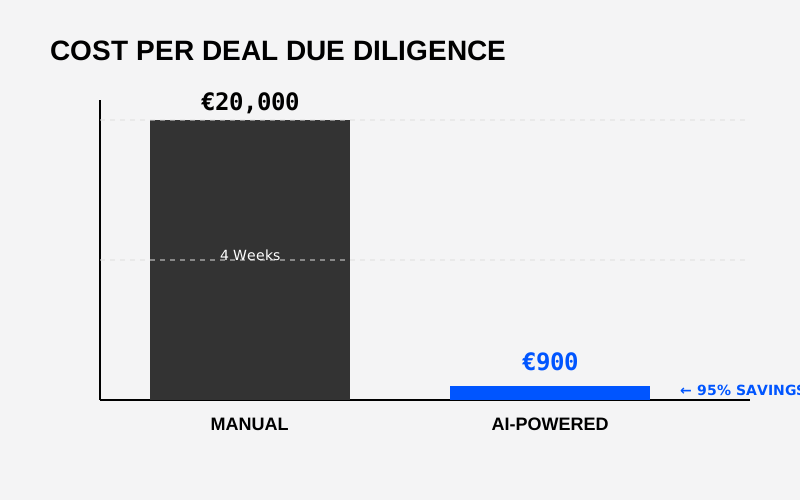
Consider the alternative. Your team uploads a data room containing sustainability reports, supplier invoices, and audit documents. Within minutes, the system returns extracted, standardized, and validated data.
Firms using automated due diligence report significant time savings:
The benefit isn’t just speed—it’s what your team does with that time. Instead of manually copying figures between documents and spreadsheets, analysts can investigate risks, question assumptions, and develop investment theses.
You might wonder: why not just upload these PDFs to ChatGPT or another general-purpose LLM?
For investment decisions, you need more than a summary. You need verified, traceable data. Generic LLMs have limitations that matter in finance:
LeapOCR approaches this differently. As an AI-native OCR engine built specifically for structured document understanding, it extracts rather than generates. Every number in the output includes source coordinates, unit verification, and validation checks.
The system follows a straightforward pipeline designed for financial documents:
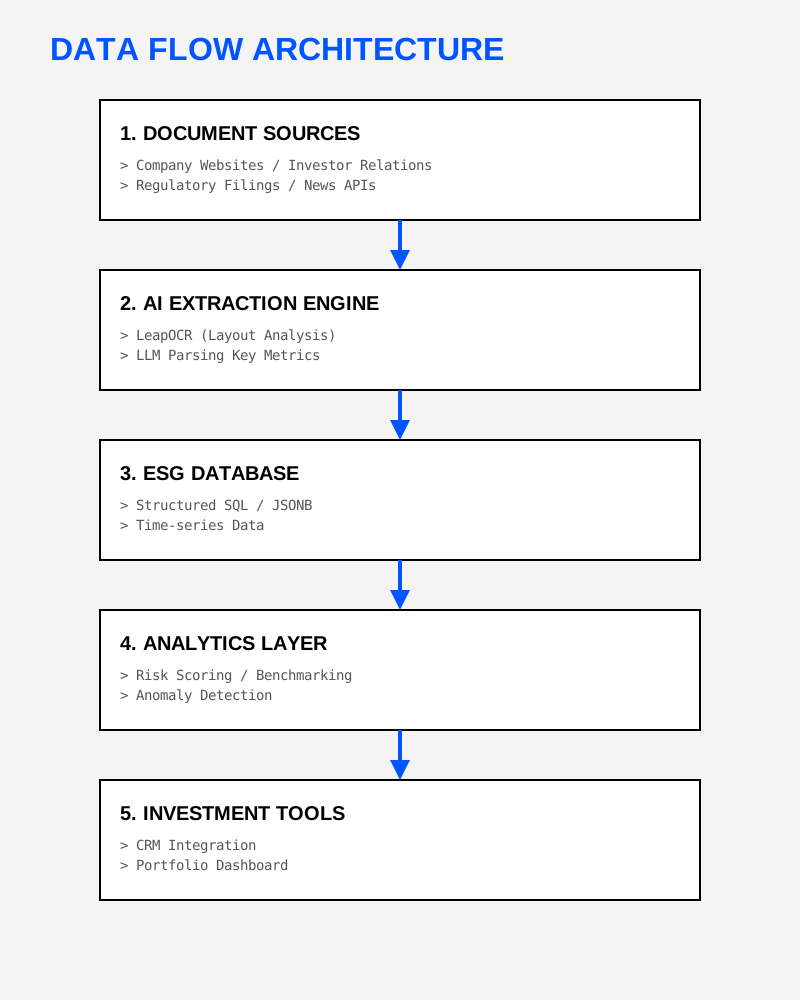
In investment due diligence, source verification matters. When a risk officer questions why carbon intensity appears low, you need more than a spreadsheet cell.
LeapOCR maintains a visual audit trail. Click any extracted figure, and the system highlights the exact location in the source document—down to the specific row and page. This traceability turns compliance from a liability into an asset.
Speed helps, but accuracy determines whether an investment thesis holds up. Traditional ESG scoring often relied on high-level ratings and qualitative judgments. AI enables more precise approaches:
Rather than sorting companies into “good” or “bad” buckets, you can build nuanced risk models that weigh multiple factors simultaneously.
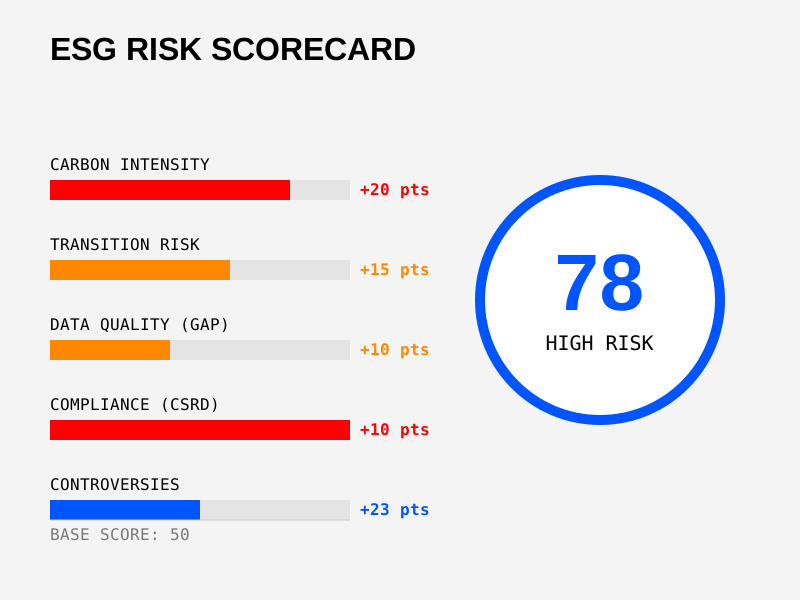
The ROI calculations—500% efficiency gains, 28x faster processing—are meaningful. But there’s another dimension that matters just as much.
It’s the analyst who finishes work at a reasonable hour instead of staying late to manually extract data. The associate who spots a critical flaw in a deal structure because they had time to think rather than copy-paste. The partner who walks into committee meetings knowing the data behind the presentation is accurate and complete.
LeapOCR doesn’t replace investment judgment. It clears away the mechanical work so judgment can be applied where it counts.
Want to see it in action?
Try LeapOCR on your own documents
Eligible paid plans include a 3-day trial with 100 credits after you add a credit card, so you can test actual PDFs, scans, and forms before committing to a rollout.
Keep reading
More implementation guides, benchmarks, and workflow notes for teams building document pipelines.
How to build a resilient, high-throughput document ingestion pipeline for logistics using LeapOCR and Go.
Stop buying a separate AI tool for every department. Learn why a unified Vision Language Model (VLM) beats the 'point solution' approach in modern healthcare.
Stop bleeding revenue to claim denials. Learn how LeapOCR's automated ICD-10 extraction turns messy clinical notes into clean, compliant codes.