Published
January 25, 2026
Standard OCR has a panic attack when it sees a doctor's handwriting. Vision Language Models (VLMs) succeed by reading like a human: using context, medical knowledge, and layout awareness to decode the indecipherable.
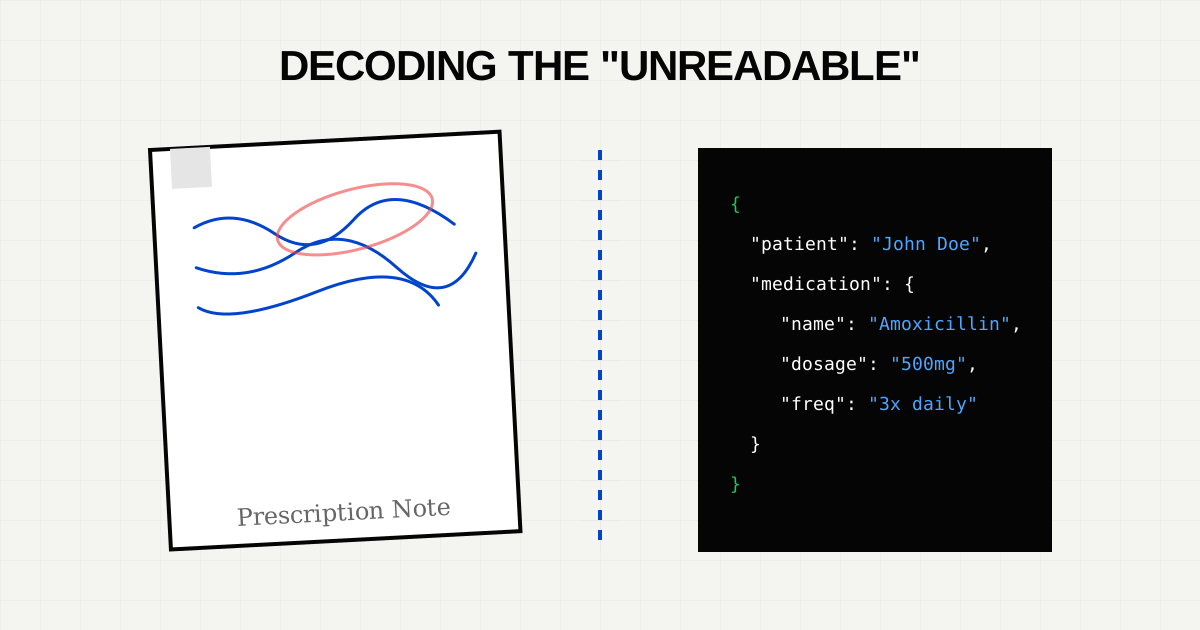
There is an old joke in healthcare: “If you can read it, a doctor didn’t write it.”
For decades, this was the hard limit of medical automation. While hospitals digitized structured data (EHRs), millions of handwritten prescriptions, intake forms, and nurse notes remained trapped in paper (or PDF) purgatory.
Legacy OCR (Optical Character Recognition) engines like Tesseract are deterministic. They look at pixel clusters and try to match them to a font. When they see a scrawled “Rx” that looks like a squiggle, they output garbage characters (R~^).
This is why medical records departments still employ armies of human transcribers.
Legacy OCR treats every character as an island. It doesn’t know that “Amoxicillin” is a valid word and “Amox!c1llin” isn’t. It just sees pixels.
When faced with:
qd, bid, prn) looks like noise to a standard model.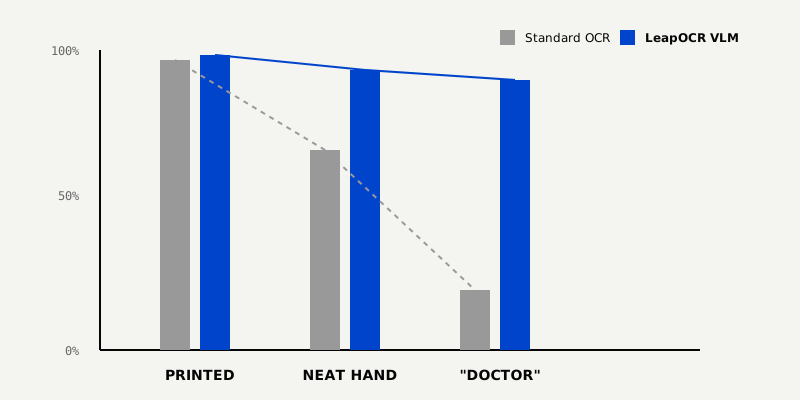
As the chart above shows, standard OCR works fine for printed letters. But as soon as you introduce cursive or “doctor’s scrawl,” accuracy plummets to ~20%. That is functionally useless for automation.
Vision Language Models (VLMs) like LeapOCR do not just “see” pixels; they “read” context. They have been trained on millions of medical documents, so they understand the semantics of healthcare.
Imagine a note says: “Pt presents with depression. Rx: [scribble] 20mg daily.”
A standard OCR sees the scribble and fails. A VLM analyzes the entire patient context:
The model infers that the scribble is likely Fluoxetine (Prozac) or Citalopram, and checks the visual features to confirm. It uses the diagnosis to decode the prescription.
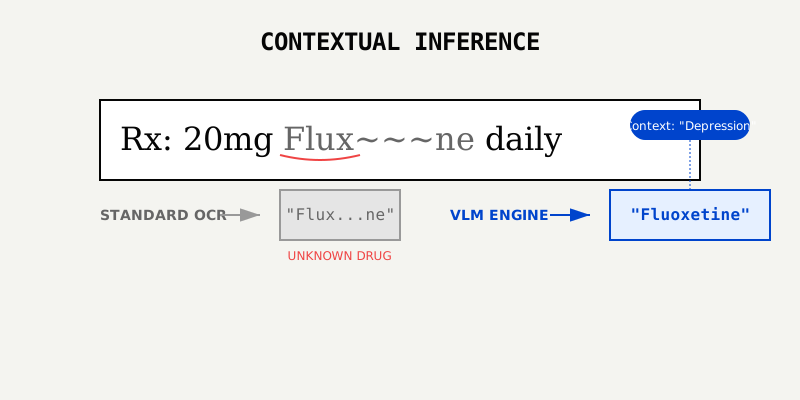
This is a fundamental shift from Perception (seeing shapes) to Cognition (understanding meaning).
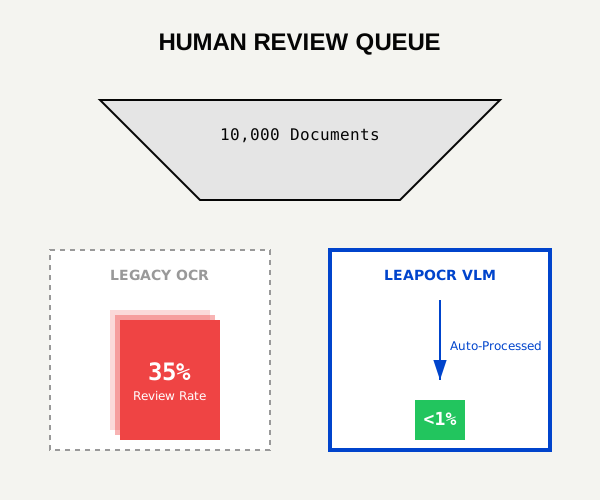
In a traditional workflow, any document with low confidence (below 90%) is kicked to a “Human Review Queue.” For handwritten medical forms, this often means 30-40% of all documents require manual data entry.
That is slow, expensive, and leads to burnout.
By switching to a VLM-based pipeline, you don’t just get better code; you fundamentally change the economics of your back office. Because VLMs can resolve ambiguity using context, they rely far less on human clarification.
You don’t need to train your own model. The integration is schema-driven. You tell LeapOCR what you expect to find, and it hunts for it.
// Define your extraction schema
{
  "patient_demographics": {
    "name": "string",
    "dob": "date"
  },
  "clinical_notes": {
    "chief_complaint": "string",
    "diagnosis_codes": ["string (ICD-10)"],
    "medications": [
      {
        "drug": "string (normalized RxNorm name)",
        "dosage": "string",
        "frequency": "string"
      }
    ]
  }
}
The VLM will return standardized JSON, normalizing “1 tab 3x a day” into frequency: "TID".
Handwriting is no longer a blocker for digital transformation in healthcare.
If your team is still manually typing data from scanned intake forms or faxed referrals, you are solving a solved problem. It is time to let the AI read the doctor’s notes, so your staff can focus on the patients.
See it in action
Try LeapOCR on your own documents
Eligible paid plans include a 3-day trial with 100 credits after you add a credit card, so you can test actual PDFs, scans, and forms before committing to a rollout.
Keep reading
More implementation guides, benchmarks, and workflow notes for teams building document pipelines.
Stop buying a separate AI tool for every department. Learn why a unified Vision Language Model (VLM) beats the 'point solution' approach in modern healthcare.
When generic extraction is not enough, fine-tuning can boost accuracy for specialty workflows.
Focus on specific examples: handwritten notes from site inspections, complex multi-page contracts, utility bills with varying formats.