Published
January 25, 2026
Medical coding automation isn't just about saving labor costs—it's about fixing your cash flow. Here is a financial framework for estimating how quickly VLM-based coding pays for itself.
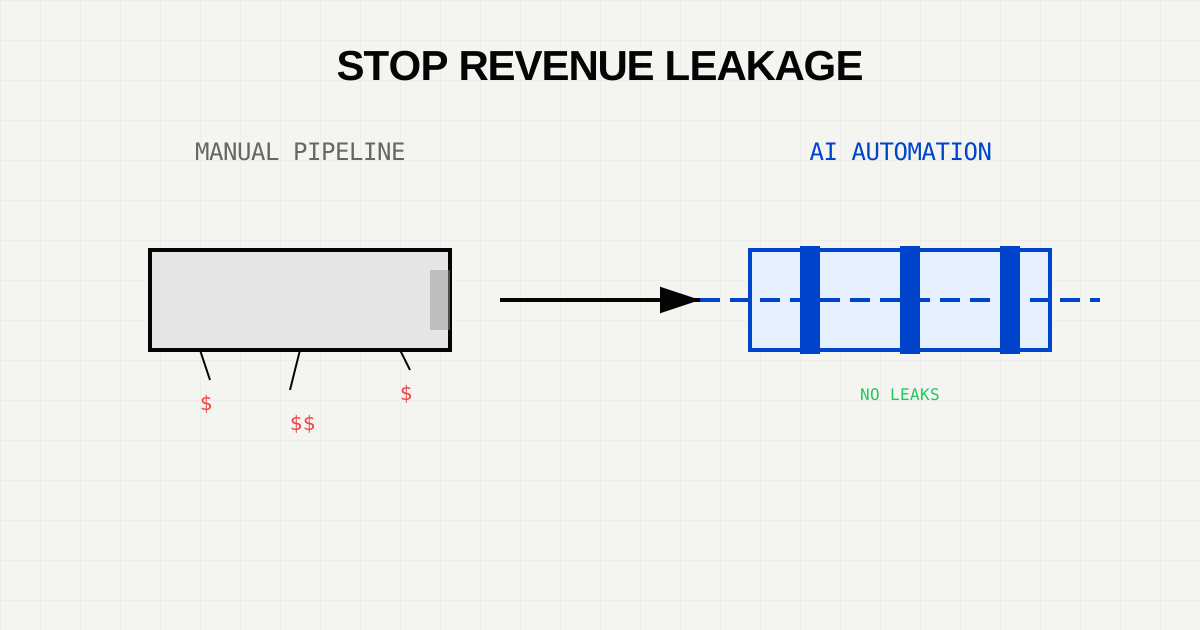
For most healthcare CFOs, medical coding is a black box. You pour money in (salaries, outsourced vendors), and hopefully, revenue comes out 45 days later.
But that “black box” is leaking.
Every day a chart sits in a “To Be Coded” queue, it is an asset depreciating. The longer it sits, the higher the risk of denial due to timely filing limits, and the longer your organization floats the operational cost without reimbursement.
Automated coding changes this physics. It doesn’t just reduce the cost of coding; it accelerates the velocity of cash.
When building a business case for automated coding, most organizations stop at Labor Savings. That is a mistake. The real ROI comes from three distinct buckets:
Manual coding is expensive. Certified coders (CPC/CCS) are hard to find and command high salaries. Even offshore vendors charge per chart or per hour rates that add up.
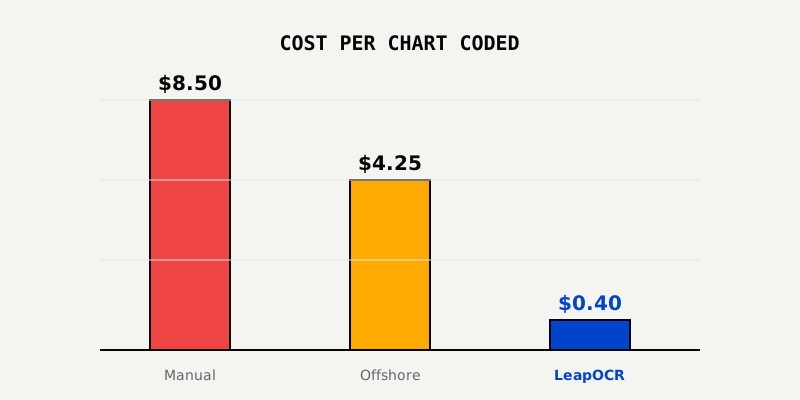
In a volume-heavy environment (e.g., Radiology, Pathology, Emergency Med), the labor arbitrage alone justifies the software investment immediately.
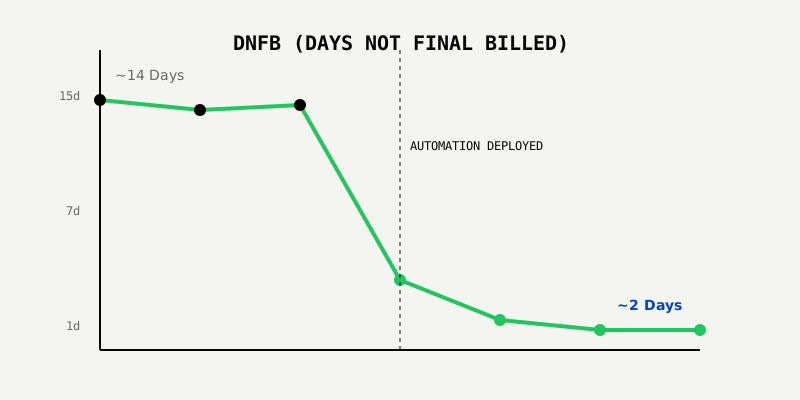
DNFB (Discharged Not Final Billed) is the metric that keeps RCM directors awake at night. It measures revenue stuck in your system—services rendered but not yet billed.
Manual teams carry a backlog. If staff gets sick, or volume spikes (e.g., flu season), the backlog grows. It is not uncommon for DNFB to sit at 10-14 days.
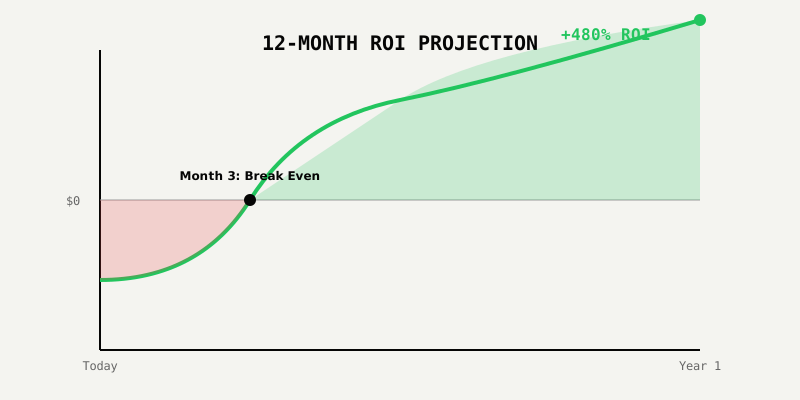
An AI model doesn’t get sick. It doesn’t take vacations. It scales instantly. deploying LeapOCR can crash DNFB from 14 days to 48 hours (or less). That is a massive one-time infusion of cash into the business.
“Rework” is the silent killer of margin. If a manual coder misses a modifier or selects an unspecific ICD-10 code, the claim bounces.
Automated coding enforces schema compliance. It won’t submit a code that conflicts with the patient’s gender or procedure date. It ensures specificity (e.g., ensuring a fracture code specifies “left” or “right”). Preventing just 10% of your current denials falls straight to the bottom line.
When you combine these factors, the ROI curve is aggressive.
Beyond the spreadsheet, consider the operational friction you are removing:
Automated medical coding is not an “IT Project.” It is a financial strategy.
If you are evaluating it solely on “can we save one FTE salary,” you are missing the forest for the trees. The goal is to turn your coding department from a bottleneck into a high-speed revenue pump.
Calculate your potential savings.
Try LeapOCR on your own documents
Eligible paid plans include a 3-day trial with 100 credits after you add a credit card, so you can test actual PDFs, scans, and forms before committing to a rollout.
Keep reading
More implementation guides, benchmarks, and workflow notes for teams building document pipelines.

How AI compares clinical documentation to billed codes to capture missed revenue without increasing audit risk.
A hypothetical case study showing how automation reduces claim errors and accelerates reimbursement.
Stop buying a separate AI tool for every department. Learn why a unified Vision Language Model (VLM) beats the 'point solution' approach in modern healthcare.